

A Freight Management System (FMS) is a specialized logistics software that automates end-to-end freight operations – from dispatch and routing to tracking and invoicing. It synchronises carriers, shippers and customers in real time, digitising tasks like route planning, load optimisation and documentation. According to recent market reports, demand for FMS solutions is surging, driven by customer expectations for faster deliveries and full visibility. In practice, a robust FMS can dramatically cut manual effort, minimise errors and deliver on-time shipments – helping logistics companies stay competitive. (Tvareet, as a leading logistics software development company, builds such tailored freight and logistics software to streamline operations.)
Why a Freight Management System is Essential
Modern logistics firms face complexity across transport modes, regulations and customer demands. A well-designed FMS streamlines these challenges. By digitising freight workflows (from quoting to delivery), companies achieve operational efficiency and better resource use. For example, real-time GPS/IoT tracking gives up-to-the-minute shipment status, so problems can be spotted and addressed promptly. Automated features (like instant load planning and e-invoicing) cut paperwork and idle time, boosting productivity. Over time, these gains translate to cost reduction (by optimising routes and minimising empty runs) and higher customer satisfaction (through accurate ETAs and transparency). In short, a custom freight management platform can transform fragmented processes into a seamless, data-driven workflow – a competitive must-have for transport businesses.
Key Features of a Freight Management System
An effective FMS integrates multiple modules. Core features typically include:
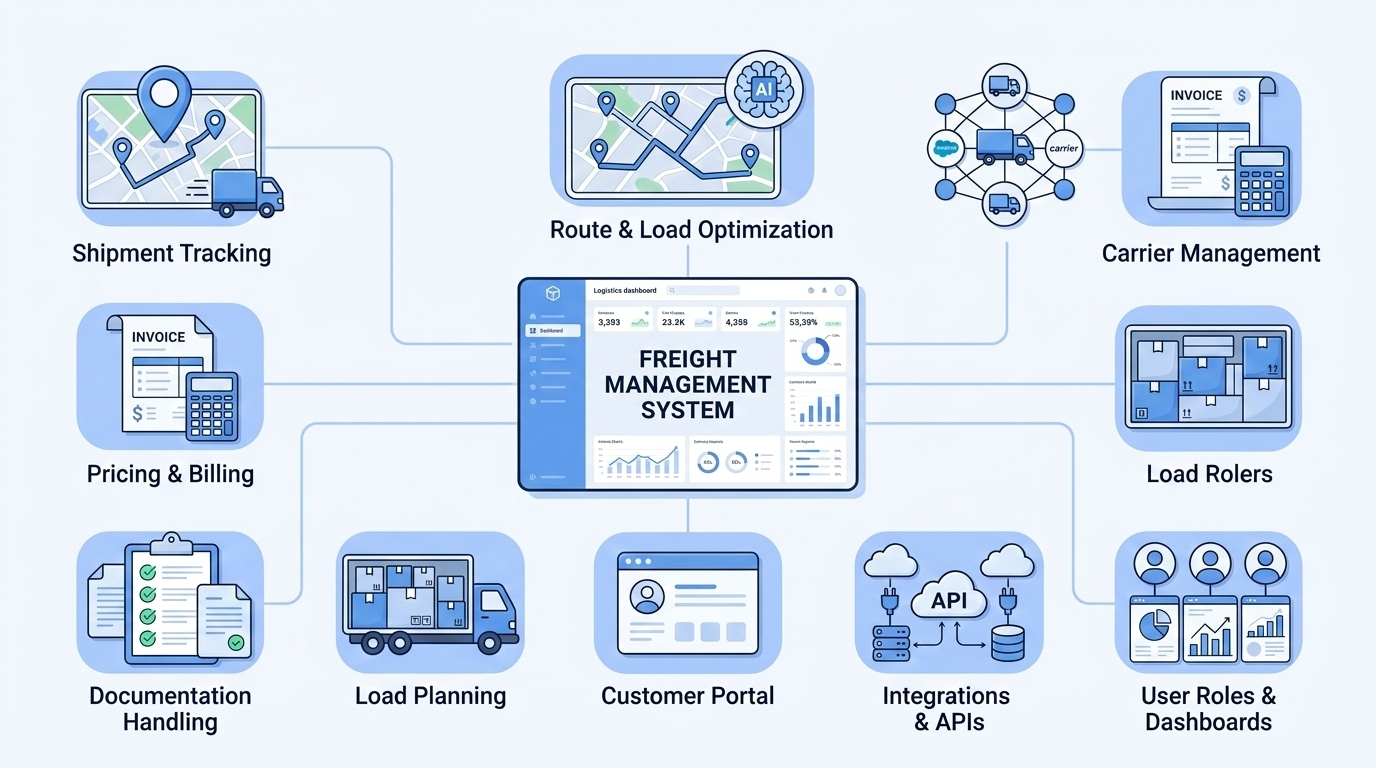
Shipment Tracking: Live GPS and IoT-based tracking of trucks, containers and parcels. This provides accurate status updates and geofencing alerts for every leg of a shipment.
Route & Load Optimization: Algorithms plan the most efficient routes and load distributions, factoring in traffic, vehicle capacity and delivery windows. This reduces fuel use and ensures timely deliveries.
Carrier Management: Tools to onboard and rate carriers. The system can automatically select the best carrier based on cost, performance and shipment needs.
Pricing & Billing: Automated freight billing, quoting and invoicing. Integrations with accounting capture shipping costs and issue invoices to clients/carriers with minimal manual input.
Documentation Handling: Secure digital storage of documents (bills of lading, customs paperwork, certificates). Digitisation speeds approvals and compliance checks, and prevents delays from missing paperwork.
Load Planning: Tools for space utilisation. The FMS optimises how goods are packed into vehicles or containers to avoid overloading and extra trips.
Customer Portal: A self-service interface for shippers. Customers can log in 24/7 to view quotes, track their orders and pay bills, reducing support overhead.
Integrations & APIs: Seamless data exchange with third-party systems – for example, ERPs, TMS/WMS, GPS trackers and carrier portals. This unified connectivity ensures all data (orders, inventory, finance) stays in sync.
User Roles & Dashboards: Role-based interfaces for different users. Administrators have full system control, managers see analytics and operational dashboards, and customers or drivers get a simplified view. For example, managers can schedule pickups, track shipments and send invoices; users can request quotes and monitor their loads.
Each of these features is designed to eliminate manual bottlenecks and improve visibility across the supply chain. Advanced FMS solutions may also include built-in analytics dashboards (for KPIs like cost-per-shipment or transit time) and compliance modules (for customs and safety regulations). Together, they form an integrated freight and logistics software suite that brings efficiency and transparency to transportation.
Development Process for Freight Management Software
Building a custom FMS follows a structured development process. The main steps are:
Requirement Analysis: Engage stakeholders (dispatchers, managers, customers) to map out workflows and pain points. Define the scope (e.g. domestic vs. international freight, number of users, reporting needs).
UI/UX Design: Create role-specific dashboards and clean interfaces for desktop and mobile. Design considerations include easy shipment tracking screens, map views and responsive layouts. Well-designed visuals and navigation ensure staff and clients can use the system efficiently.
Backend Development: Implement the core logic and data model. Developers typically use robust languages like Java, Python or Node.js (with frameworks such as Spring, Django or Express) to build scalable microservices. This includes setting up databases (SQL/NoSQL), business rules (route calculations, invoicing logic) and security layers.
API & Third-Party Integrations: Develop interfaces to connect the FMS with external systems. This may include real-time GPS devices, carrier shipping APIs, ERP/CRM systems and payment gateways. For example, integrating with a GPS API provides live location updates, while EDI or REST integrations sync orders and shipments across platforms.
Testing & QA: Perform thorough testing – functional (all features work as intended), performance (system handles peak loads and real-time data), usability (end-user interfaces are intuitive) and security (penetration tests, data encryption checks). Compliance testing is also essential if international shipping rules are involved.
Deployment & Maintenance: Launch the FMS on a secure, scalable environment (often cloud-hosted on AWS/Azure). Post-launch, the development team provides monitoring, bug fixes and regular updates (adding new routes, carriers, or features). Ongoing support ensures uptime for mission-critical logistics operations.
Following an agile methodology (iterative development with regular feedback) is common. This lets developers deliver working modules quickly and refine them based on user input, reducing project risk. By working through these stages with a skilled logistics software development company, you ensure the final FMS meets both operational goals and industry standards.
Technology Stack for Modern FMS
A modern FMS relies on an enterprise-grade tech stack. Key components include:
Cloud & Infrastructure: Solutions typically run on cloud platforms (AWS, Azure or Google Cloud) for scalability and high availability. Containerisation (Docker, Kubernetes) and IaC tools (Terraform) support reliable deployment.
Backend: Popular choices are Java (Spring Boot), Python (Django), or Node.js (Express). These allow fast processing of logistics workflows and real-time data (e.g. route calculations, inventory). High-performance messaging (Apache Kafka, RabbitMQ) or MQTT (for IoT sensors) handle live updates and telemetry.
Databases & Data: Both relational and NoSQL databases are used. PostgreSQL or MySQL store structured data (clients, orders), while MongoDB or Cassandra handle large unstructured datasets (tracking logs, IoT data). Data warehouses or streaming platforms (Snowflake, Databricks) may be added for analytics.
Frontend: Web and mobile UIs are often built with React, Angular or Vue.js. Native or cross-platform frameworks (React Native, Flutter) cover mobile apps for drivers or clients. These tools enable responsive dashboards and mapping interfaces.
Mapping & Geospatial: APIs like Google Maps, HERE or OpenStreetMap provide route mapping, geocoding and traffic data. Geospatial databases (PostGIS) support location queries.
Analytics & AI: Machine learning libraries (TensorFlow, PyTorch, OR-Tools) enable features like demand forecasting, predictive ETA and dynamic routing. AI models can optimise load planning or forecast shipment volumes.
Integrations: REST/GraphQL APIs connect modules internally. Industry standards like EDI (X12, EDIFACT) link with carriers. Tools like MuleSoft or Dell Boomi may be used for complex enterprise integrations.
Security & Compliance: Robust security is essential. Implement OAuth2/2FA for user access, TLS encryption for data in transit, and encrypted storage at rest. Compliance with standards (GDPR, ISO 27001, customs regimes) is built in.
In summary, a typical tech stack might involve a cloud-native microservices architecture: back-end services in Java/Python, a React or Angular user interface, Kafka or MQTT for real-time pipelines, and databases like PostgreSQL/MongoDB. Third-party tools (Twilio for SMS/2FA, Stripe/PayPal for payments) are integrated as needed. This combination of technologies ensures the FMS is scalable, reliable and future-proof. As one industry guide notes, “using advanced technologies like microservices, AI/ML libraries, cloud-native frameworks or IoT integrations can improve performance and scalability”.
Estimating Cost: Development and Maintenance
Building a custom FMS is a significant investment. Development cost depends on scope, complexity and team location. Industry benchmarks suggest a basic FMS prototype (MVP) may start in the tens of thousands of dollars, while a full-featured enterprise solution can exceed $100k. For example, one cost estimate breaks down freight software development phases as:
Requirement & Planning: $3k–$5k – workshops, tech research and specifications.
UI/UX Design: $4k–$6k – wireframes, prototyping, and user testing.
Core Development: $15k–$30k – coding the main freight modules (tracking, routing, etc.).
API Integrations: $5k–$10k – connecting carriers, ERPs and GPS systems.
Testing & QA: $4k–$7k – functional, performance and security testing.
Deployment & Support: $3k–$6k – initial cloud setup and go-live support.
Summing these phases gives an estimated range of roughly $34k–$64k for a mid-sized project. However, real costs vary widely. Key factors include:
Feature Complexity: Incorporating AI, advanced analytics or blockchain greatly raises development time and cost.
Third-Party Integrations: Connecting to external systems (carrier networks, customs APIs, ERP) requires additional coding and testing, adding to the budget.
Scale & Users: A system for thousands of shipments per day (or multi-tenant 3PL) demands more servers, licenses and testing, increasing cost.
Team Location: Developer rates differ by region. For instance, hourly rates can be $100–$160/hr in the US/Western Europe versus $25–$60/hr in India. Many companies use offshore or hybrid teams to balance expertise and price.
Maintenance & Updates: Ongoing costs (hosting, 24/7 support, feature upgrades) should be budgeted at roughly 15–20% of initial development cost per year.
In practice, budgets often align to MVP vs Enterprise tiers. A small-to-medium FMS with core tracking and billing might cost $25k–$40k, whereas a global-scale platform (multi-carrier management, IoT sensors, AI analytics and compliance automation) could reach $70k–$150k+. Working with experienced developers (especially those specialising in logistics software) helps refine requirements and manage costs.
Choosing the Right Logistics Software Development Partner
For complex freight projects, partnering with a specialist logistics software development company is critical. A seasoned partner brings domain knowledge (transport, customs, warehousing) and proven tech practices. For example, Tvareet’s logistics team emphasises an agile process to deliver value quickly and adapt to change. We enforce strict data security (end-to-end encryption and NDAs) to protect sensitive shipment and financial data. Importantly, 24/7 support means any downtime or bugs are addressed at once – crucial for logistics operations that run round-the-clock.
A good partner will also help you choose the most suitable tech stack for your needs. Whether you need mobile driver apps (React Native/Flutter), real-time engines (Kafka/Redis) or heavy data processing (Elasticsearch, Snowflake), they can tailor the architecture. As one industry expert notes, “by choosing the right tech stack and development partner, businesses can customise their freight management system software to match specific workflows, customer demands, and regulatory environments”. In short, the right development team ensures your FMS not only works today, but scales and evolves with your business.
Conclusion
Building a freight management system is a major undertaking, but the payoff is a highly efficient, transparent logistics operation. By combining the right features (tracking, billing, integrations), a modern tech stack (cloud, microservices, IoT) and careful planning, companies can gain a competitive edge through digitisation. Costs can range from tens to hundreds of thousands of dollars depending on scope, so it’s vital to plan carefully and choose experienced partners. At Tvareet, our logistics software development services specialise in custom freight and transport solutions. We have deep expertise in freight and logistics software – from single-carrier apps to end-to-end supply chain platforms – and can guide you through design, development and deployment to make your FMS project a success.
FAQ’s
1. What is the difference between a TMS and a Freight Management System?
A Transportation Management System (TMS) mainly focuses on transportation planning and carrier selection, while a Freight Management System covers broader operations such as:
Shipment tracking
Freight billing
Carrier management
Route optimization
Document management
Customer portals
Many modern logistics platforms combine both functionalities into a single freight and logistics software platform.
2. How long does it take to build a Freight Management System?
The development timeline depends on the complexity of the system.
Typical timelines:
System Type | Estimated Time |
|---|---|
MVP Freight Management Software | 3 – 4 months |
Mid-scale Logistics Platform | 5 – 7 months |
Enterprise Freight Management System | 8 – 12 months |
A skilled logistics software development company can accelerate development using modern frameworks and microservices architecture.
3. How much does freight management software cost?
The cost depends on features, integrations, and scalability.
Typical development cost ranges:
Basic MVP: $25,000 – $40,000
Mid-level platform: $40,000 – $80,000
Enterprise logistics software: $80,000 – $150,000+
Additional costs may include:
Cloud hosting
API integrations
Maintenance
Support
Working with a reliable logistics software development company helps control development costs while building scalable software.
4. What businesses need freight and logistics software?
Many industries benefit from freight management software, including:
Logistics companies
Freight forwarders
3PL companies
Courier and delivery services
E-commerce companies
Supply chain businesses
Fleet management companies
Any company managing large shipment volumes can improve efficiency using logistics automation tools.
5. What technologies are used to build logistics software?
Modern freight and logistics software typically uses the following technologies:
Frontend
React.js
Angular
Vue.js
Backend
Node.js
Java (Spring Boot)
Python (Django)
Databases
PostgreSQL
MongoDB
Cloud Infrastructure
AWS
Google Cloud
Azure
Mapping & Tracking
Google Maps API
Mapbox
GPS tracking APIs
Analytics & AI
Machine learning for route optimization
Predictive delivery analytics
6. Why should businesses invest in custom logistics software?
Off-the-shelf logistics platforms often cannot meet specific operational needs.
Custom freight and logistics software allows businesses to:
Automate manual processes
Improve delivery tracking
Optimize fleet operations
Integrate with existing ERP or CRM systems
Scale logistics operations
A specialized logistics software development company can build tailored solutions that align with business workflows.