

Complete Logistics App Development Process for Supply Chain Businesses in Canada, USA, UAE, UK & Australia
Custom logistics software development has become a critical investment for supply chain and transportation businesses operating in Canada, USA, UAE, UK, and Australia. Increasing operational complexity, real-time shipment tracking requirements, cross-border trade regulations, and rising fuel and labor costs demand scalable, workflow-specific digital infrastructure. Off-the-shelf logistics platforms fail to address unique operational models, making custom logistics software service provision essential for long-term efficiency and competitive advantage.
A professional logistics software development company delivers end-to-end custom logistics software solutions including transport management system (TMS) development, warehouse management system (WMS) development, fleet management software development, supply chain management software, and real-time shipment tracking platforms. These systems are engineered to automate dispatch operations, optimize route planning, enhance fleet tracking, streamline warehouse inventory management, and integrate seamlessly with ERP systems, accounting software, GPS providers, and third-party logistics APIs.
The logistics app development process begins with detailed business workflow analysis and compliance assessment tailored to regional requirements such as GDPR in the UK, PIPEDA in Canada, federal and state regulations in the USA, data protection standards in the UAE, and Privacy Act compliance in Australia. This ensures secure, scalable, and regulation-ready logistics software architecture.
Custom logistics software service provision includes technical architecture design, cloud-native infrastructure setup, API-first development, secure database engineering, real-time analytics dashboard creation, AI-based route optimization modules, and predictive demand forecasting systems. Modern logistics software development prioritizes microservices architecture, role-based access control, end-to-end encryption, and multi-region cloud deployment to support cross-border supply chain operations.
For logistics companies operating in competitive markets such as Canada, USA, UAE, UK, and Australia, investing in custom logistics software development ensures operational automation, improved fleet utilization, enhanced shipment visibility, regulatory compliance, and scalable digital transformation. A structured logistics app development process guarantees performance optimization, integration readiness, and long-term system adaptability aligned with business growth objectives.
The Rising Demand for Custom Logistics Software in Canada, USA, UAE, UK & Australia
The demand for custom logistics software development is accelerating across Canada, USA, UAE, UK, and Australia as supply chain networks become more complex and digitally interconnected. Logistics companies operating in these regions face increasing pressure to optimize fleet operations, automate dispatch management, ensure regulatory compliance, and deliver real-time shipment visibility. Generic logistics platforms and subscription-based transport management tools are no longer sufficient to meet region-specific operational requirements.
Custom logistics software service provision enables transportation companies, freight operators, warehouse networks, and third-party logistics (3PL) providers to implement scalable, workflow-specific logistics systems tailored to their infrastructure. Businesses across North America, Europe, the Middle East, and Australia are investing in transport management system (TMS) development, warehouse management system (WMS) development, fleet tracking software, and supply chain automation platforms to gain operational control and cost efficiency.
Key drivers behind the rising demand include:
Expansion of e-commerce logistics and last-mile delivery networks
Cross-border trade growth between Canada, USA, UK, UAE, and Australia
Increasing fuel cost volatility requiring route optimization software
Real-time GPS fleet tracking requirements
Warehouse automation and inventory digitization initiatives
Regulatory compliance mandates (GDPR in the UK, PIPEDA in Canada, Privacy Act in Australia, data protection regulations in UAE, federal and state-level regulations in USA)
Demand for predictive analytics and AI-based logistics optimization
Integration needs with ERP systems, CRM platforms, accounting software, and customs clearance systems
In the USA and Canada, long-haul freight operations require advanced route planning algorithms and multi-state dispatch management systems. In the UAE, logistics hubs supporting global trade require scalable cloud-based supply chain platforms. In the UK and Australia, compliance-driven digital transformation initiatives are pushing companies toward secure and regulation-aligned custom logistics software solutions.
Custom logistics software development ensures:
Automated dispatch workflows
Real-time shipment tracking
Fleet performance monitoring
Warehouse inventory optimization
Data-driven operational decision-making
For logistics enterprises operating in Canada, USA, UAE, UK, and Australia, custom logistics software service provision is no longer optional; it is a strategic investment in scalable supply chain infrastructure and long-term competitive positioning.
Why Businesses Choose Custom Logistics Software Development
Businesses across Canada, USA, UAE, UK, and Australia are increasingly choosing custom logistics software development over generic, subscription-based logistics platforms due to scalability limitations, integration constraints, and workflow mismatches in off-the-shelf systems. Modern supply chain operations require precision-engineered digital infrastructure that aligns directly with operational processes, regulatory frameworks, and long-term growth strategies.
Custom logistics software service provision enables logistics companies, freight carriers, warehouse operators, and third-party logistics (3PL) providers to design and deploy tailored transport management systems (TMS), warehouse management systems (WMS), fleet management software, and supply chain automation platforms that reflect their exact business model.
Key reasons businesses invest in custom logistics software development include:
Workflow-Specific Automation: Custom logistics software aligns with existing dispatch processes, warehouse inventory flows, and fleet management structures without forcing operational restructuring.
Scalable Cloud Infrastructure: Cloud-native logistics platforms support multi-location operations across Canada, USA, UAE, UK, and Australia with auto-scaling and multi-region deployment.
Advanced Route Optimization & Fleet Tracking: AI-powered route planning, real-time GPS tracking, and fuel efficiency analytics improve delivery performance and reduce operational costs.
Seamless System Integration: Custom logistics software integrates with ERP systems, accounting platforms, CRM tools, IoT sensors, payment gateways, and customs clearance APIs.
Regulatory Compliance Alignment: Tailored solutions address GDPR in the UK, PIPEDA in Canada, federal and state compliance in the USA, data protection regulations in the UAE, and Privacy Act standards in Australia.
Data Ownership & Security Control: Businesses retain full control over source code, infrastructure, and sensitive shipment data with end-to-end encryption and role-based access management.
Operational Cost Optimization: Automated dispatch systems, predictive maintenance modules, and warehouse automation reduce manual labor and minimize inefficiencies.
Long-Term ROI & Feature Expansion: Custom logistics software development allows continuous enhancement through AI-based demand forecasting, analytics dashboards, and performance monitoring modules.
Unlike rigid SaaS logistics tools, custom logistics software service provision ensures that system architecture evolves alongside fleet expansion, cross-border trade growth, and warehouse network scaling. Businesses operating in competitive logistics markets such as Canada, USA, UAE, UK, and Australia require flexible, integration-ready, and performance-optimized software infrastructure.
Custom logistics software development provides measurable improvements in dispatch efficiency, shipment visibility, fleet utilization, warehouse productivity, and supply chain transparency. For enterprises seeking digital transformation within transportation and logistics operations, tailored logistics software solutions offer strategic operational control and sustainable competitive advantage.
What Is Custom Logistics Software Service Provision?
Custom logistics software service provision refers to the end-to-end design, development, deployment, integration, and maintenance of tailored digital systems built specifically for logistics, transportation, freight forwarding, warehouse management, and supply chain operations. Unlike off-the-shelf logistics platforms, custom logistics software solutions are engineered to match a company’s exact operational workflows, compliance requirements, and scalability goals.
In highly competitive markets such as Canada, USA, UAE, UK, and Australia, logistics companies require specialized transport management systems (TMS), warehouse management systems (WMS), fleet management software, last-mile delivery platforms, and supply chain automation tools that align precisely with their infrastructure. Custom logistics software development enables businesses to build proprietary systems that optimize dispatch operations, real-time shipment tracking, route planning, inventory management, and regulatory compliance management.
Custom logistics software service provision typically includes:
1. Business Process Analysis & Technical Architecture Planning
A detailed evaluation of existing logistics workflows, fleet structures, warehouse processes, and supply chain networks. This phase defines system requirements, database architecture, cloud infrastructure design, API integration strategy, and cybersecurity protocols.
2. Custom Software Design & Development
Development of logistics applications tailored to operational needs, including:
Transport Management System (TMS) development
Warehouse Management System (WMS) development
Fleet tracking and GPS monitoring software
Route optimization algorithms
Automated dispatch management systems
Freight billing and invoicing modules
Supply chain analytics dashboards
Solutions may be built as cloud-based logistics software, on-premise enterprise systems, or hybrid logistics platforms depending on security and scalability requirements.
3. System Integration & API Connectivity
Custom logistics software integrates with ERP systems, CRM platforms, accounting software, customs clearance databases, IoT tracking devices, RFID systems, fuel monitoring tools, and third-party carrier APIs. Seamless integration ensures centralized operational control and real-time data synchronization.
4. Compliance & Security Implementation
Logistics operations in Canada, USA, UAE, UK, and Australia must comply with data protection regulations, cross-border trade laws, and regional transportation policies. Custom logistics software service provision includes secure data encryption, role-based access control, audit trails, and compliance-ready reporting modules.
5. Testing, Deployment & Cloud Optimization
Comprehensive testing includes load testing, security testing, performance optimization, and cross-platform compatibility validation. Deployment may utilize scalable cloud infrastructure (AWS, Azure, or private cloud environments) to support multi-location operations.
6. Ongoing Maintenance & System Enhancement
Continuous software updates, AI integration, predictive analytics upgrades, feature expansion, and technical support ensure long-term operational efficiency and return on investment.
Custom logistics software service provision empowers logistics enterprises to build proprietary digital infrastructure instead of relying on generic SaaS tools. It enables automation of dispatch workflows, optimization of fleet utilization, warehouse inventory accuracy, real-time shipment visibility, and data-driven decision-making.
For supply chain businesses in Canada, USA, UAE, UK, and Australia, custom logistics software development is not merely application development—it is strategic digital transformation that strengthens operational control, reduces logistics costs, enhances scalability, and improves competitive positioning in global transportation markets.
Core Logistics Software Solutions Delivered Through Custom Development
Custom logistics software development enables transportation companies, freight forwarders, warehouse operators, third-party logistics (3PL) providers, and supply chain enterprises in Canada, USA, UAE, UK, and Australia to deploy specialized digital systems tailored to their operational infrastructure. Unlike generic SaaS logistics platforms, custom logistics software service provision delivers fully scalable, integration-ready, and compliance-aligned enterprise solutions.
Below are the core logistics software solutions typically delivered through custom development.
1. Custom Transport Management System (TMS) Development
A custom Transport Management System (TMS) is the backbone of modern freight and transportation operations. It centralizes shipment planning, carrier management, freight billing, dispatch coordination, and route optimization.
Key functionalities include:
Automated load planning and carrier allocation
Real-time freight tracking and shipment visibility
Multi-modal transport management (road, air, sea, rail)
Freight rate management and contract integration
Electronic Proof of Delivery (ePOD) systems
Cross-border documentation management
Fuel cost tracking and route efficiency analytics
For logistics companies operating across Canada–USA trade routes, UK–EU corridors, UAE global shipping hubs, and Australian interstate freight networks, a custom TMS ensures regulatory compliance, scalable multi-location operations, and real-time operational control.
2. Custom Warehouse Management System (WMS) Development
Warehouse operations require precision inventory tracking, automated picking workflows, and optimized storage allocation. Custom Warehouse Management System (WMS) development enables logistics enterprises to streamline warehouse processes and improve inventory accuracy.
Core WMS features include:
Real-time inventory management
Barcode and RFID integration
Automated picking and packing workflows
Batch tracking and serial number tracking
Multi-warehouse management
Warehouse space optimization algorithms
Inventory forecasting and demand planning
Custom WMS solutions integrate seamlessly with ERP systems, accounting software, procurement platforms, and e-commerce fulfillment systems. For supply chain businesses in Canada, USA, UAE, UK, and Australia, warehouse automation software significantly reduces human error and improves order fulfillment speed.
3. Fleet Management & GPS Tracking Software
Fleet management software is critical for logistics companies operating large vehicle networks. Custom fleet tracking systems provide real-time GPS monitoring, driver behavior analytics, fuel consumption tracking, and predictive vehicle maintenance alerts.
Core capabilities include:
Live vehicle location tracking
Route deviation alerts
Driver performance monitoring
Fuel efficiency analytics
Vehicle maintenance scheduling
Telematics data integration
Geofencing and automated notifications
AI-powered fleet management software improves route optimization, reduces idle time, lowers fuel costs, and enhances on-time delivery performance across transportation networks in North America, Europe, the Middle East, and Australia.
4. Last-Mile Delivery Management Software
E-commerce expansion has intensified the demand for last-mile delivery software solutions. Custom last-mile logistics platforms optimize delivery routes, manage dispatch workflows, and provide real-time tracking updates to customers.
Features include:
Dynamic route optimization
Delivery slot scheduling
Mobile driver applications
Real-time customer notifications
Proof of delivery capture
Reverse logistics management
Performance analytics dashboards
Custom last-mile delivery management systems are especially critical in urban logistics markets such as Toronto, New York, London, Dubai, and Sydney, where delivery density and traffic congestion demand intelligent route planning.
5. Supply Chain Analytics & Business Intelligence Platforms
Data-driven logistics operations require advanced supply chain analytics platforms. Custom logistics software development includes business intelligence dashboards that transform operational data into actionable insights.
Capabilities include:
Real-time KPI tracking
Freight cost analysis
Delivery performance metrics
Inventory turnover analysis
Predictive demand forecasting
AI-based risk assessment
Supply chain bottleneck detection
These analytics modules enable strategic decision-making and long-term cost optimization for logistics enterprises across Canada, USA, UAE, UK, and Australia.
6. Freight Forwarding & Customs Management Software
International logistics operations require compliance with customs regulations, trade documentation, and tariff structures. Custom freight forwarding software automates:
Bill of Lading generation
Customs clearance documentation
Tariff calculation
Multi-currency invoicing
Trade compliance verification
Shipment milestone tracking
Custom logistics software service provision ensures seamless integration with customs APIs, port authorities, and global carrier networks.
7. ERP & Third-Party System Integration
A core advantage of custom logistics software development is seamless integration with enterprise systems, including:
ERP systems (SAP, Oracle, Microsoft Dynamics)
CRM platforms
Accounting software
Payment gateways
IoT tracking devices
Fuel monitoring systems
E-commerce platforms
API-driven integration ensures centralized data flow, eliminating operational silos and enabling real-time synchronization across departments.
8. Cloud-Based Logistics Platforms & SaaS Architecture
Modern logistics companies require cloud-native infrastructure for scalability and performance. Custom logistics software solutions may be built using AWS, Microsoft Azure, or private cloud environments to support:
Multi-location operations
High-availability architecture
Data redundancy and backup
Disaster recovery systems
Secure remote access
Cloud-based logistics platforms ensure uninterrupted operations for enterprises operating across multiple countries and time zones.
9. Compliance, Security & Data Protection Modules
Logistics software in Canada, USA, UAE, UK, and Australia must comply with regional data protection and transportation regulations. Custom solutions incorporate:
End-to-end data encryption
Role-based access control
Audit logs and activity tracking
GDPR compliance modules
Secure API authentication
Cybersecurity risk monitoring
This ensures protection of sensitive shipment data, financial records, and operational intelligence.
Strategic Impact of Custom Logistics Software Development
Core logistics software solutions delivered through custom development empower businesses to automate operations, enhance shipment visibility, reduce operational costs, and scale infrastructure without system limitations. By deploying tailored transport management systems, warehouse management systems, fleet tracking software, and supply chain analytics platforms, logistics enterprises gain full operational control and long-term competitive advantage.
For supply chain businesses in Canada, USA, UAE, UK, and Australia, custom logistics software service provision is a strategic investment in digital transformation, operational efficiency, regulatory compliance, and scalable growth within global transportation and logistics markets.
Complete Logistics App Development Process
The complete logistics app development process involves a structured, end-to-end approach to designing, building, deploying, and scaling custom logistics software solutions tailored for transportation, freight forwarding, warehouse management, and supply chain enterprises in Canada, USA, UAE, UK, and Australia. Custom logistics software development requires strategic planning, technical architecture precision, regulatory compliance alignment, and performance optimization.
Below is the structured logistics application development lifecycle followed in professional custom logistics software service provision.
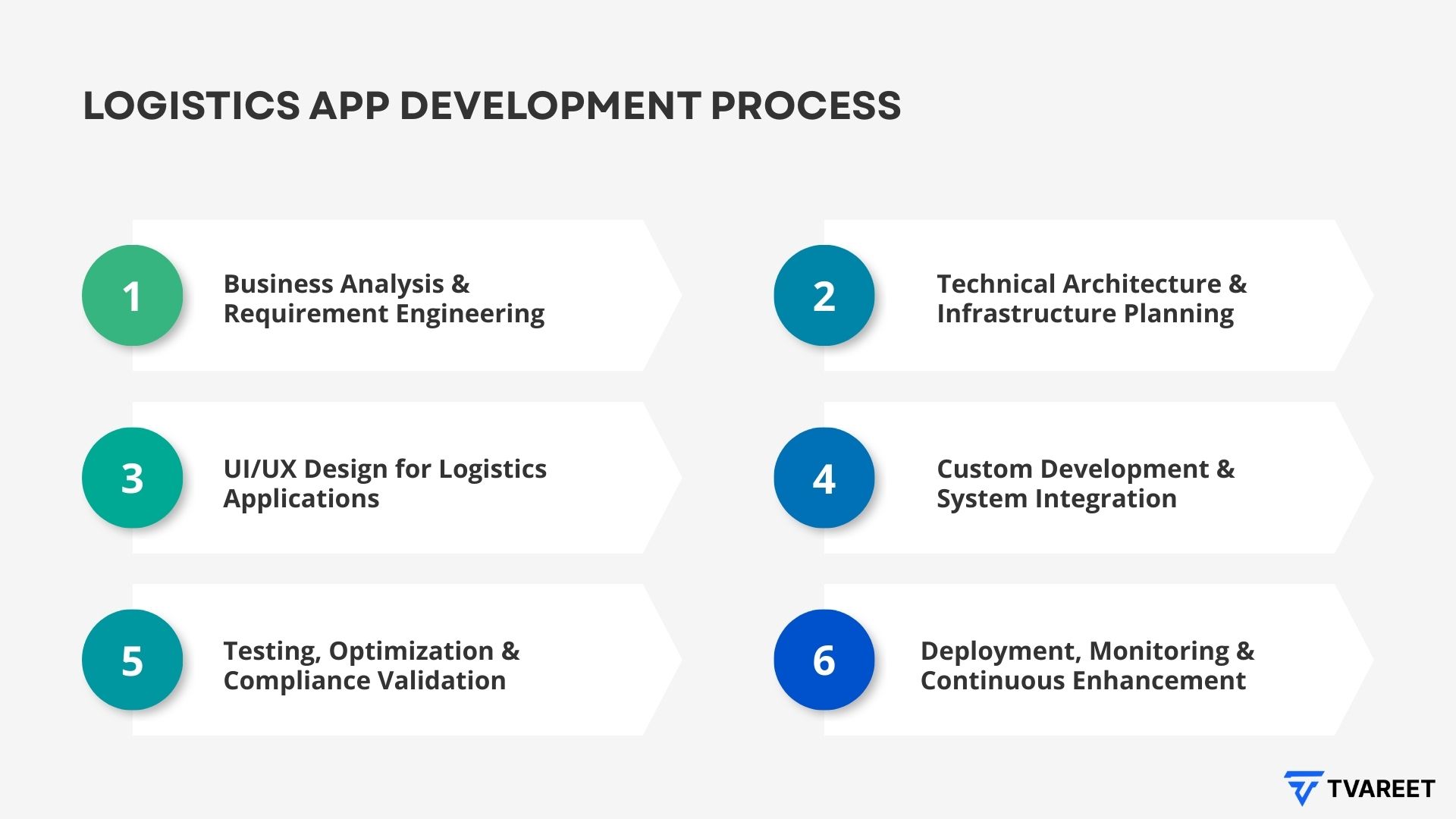
1. Business Analysis & Requirement Engineering
The process begins with in-depth logistics workflow analysis, fleet structure evaluation, warehouse operations mapping, and supply chain network assessment. This phase identifies:
Transport Management System (TMS) requirements
Warehouse Management System (WMS) functionalities
Fleet tracking and GPS integration needs
Route optimization logic
Compliance and reporting requirements
ERP, CRM, and third-party API integration points
A detailed Software Requirement Specification (SRS) is prepared to define system scope, scalability goals, user roles, and security protocols.
2. Technical Architecture & Infrastructure Planning
Custom logistics app development requires scalable cloud architecture design. This phase defines:
Cloud deployment strategy (AWS, Azure, private cloud)
Microservices architecture or monolithic framework selection
Database structure (SQL/NoSQL)
API architecture for third-party integration
Cybersecurity framework (encryption, authentication, access control)
Infrastructure is designed to support real-time shipment tracking, high-volume data processing, and multi-location logistics operations.
3. UI/UX Design for Logistics Applications
User interface design focuses on operational efficiency for dispatch managers, warehouse staff, fleet operators, and administrators. Wireframes and prototypes are developed for:
Real-time shipment dashboards
Fleet tracking maps
Inventory management panels
Automated dispatch modules
Analytics and reporting screens
Logistics app UI/UX prioritizes clarity, speed, and workflow automation.
4. Custom Development & System Integration
Developers build core modules including TMS, WMS, fleet management software, last-mile delivery systems, freight billing engines, and supply chain analytics dashboards. API integration connects the logistics app with ERP systems, accounting software, IoT devices, customs databases, and payment gateways.
5. Testing, Optimization & Compliance Validation
Comprehensive testing includes:
Performance testing for high-load logistics operations
Security testing and vulnerability assessments
Cross-device and cross-platform compatibility
Compliance validation (GDPR, PIPEDA, regional data laws)
System optimization ensures real-time data synchronization and minimal latency.
6. Deployment, Monitoring & Continuous Enhancement
The final stage includes production deployment, cloud scaling configuration, monitoring dashboards, and ongoing maintenance. Continuous improvement integrates AI-based route optimization, predictive analytics, and automation enhancements.
The complete logistics app development process ensures secure, scalable, and high-performance custom logistics software solutions aligned with global transportation and supply chain industry standards.
Cost of Custom Logistics Software Development
The cost of custom logistics software development varies significantly depending on system complexity, feature scope, infrastructure requirements, compliance standards, and geographic deployment across Canada, USA, UAE, UK, and Australia. Unlike subscription-based SaaS logistics tools, custom logistics software service provision involves strategic architecture planning, tailored feature development, API integrations, cloud infrastructure configuration, cybersecurity implementation, and long-term scalability engineering.
Businesses investing in custom transport management systems (TMS), warehouse management systems (WMS), fleet management software, last-mile delivery platforms, and supply chain automation solutions must evaluate both development costs and long-term return on investment (ROI).
Key Cost Factors in Custom Logistics Software Development
1. System Complexity & Feature Set
The more advanced the logistics platform, the higher the development cost. Core modules influencing pricing include:
Real-time GPS fleet tracking integration
AI-based route optimization algorithms
Automated dispatch management systems
Multi-warehouse inventory management
Freight billing and invoicing engines
Customs compliance automation
Business intelligence dashboards
Predictive analytics and demand forecasting
Basic logistics app development with limited features will cost significantly less than enterprise-grade supply chain management platforms.
2. Platform Type & Deployment Model
Web-based logistics software
Mobile logistics applications (iOS & Android)
Cloud-based logistics platforms (AWS, Azure, hybrid cloud)
On-premise enterprise logistics systems
Cloud-native, scalable infrastructure typically increases initial development cost but reduces long-term operational overhead.
3. Integration Requirements
Custom logistics software development often requires integration with:
ERP systems (SAP, Oracle, Microsoft Dynamics)
CRM platforms
Accounting software
IoT tracking devices
RFID systems
Customs and freight APIs
Payment gateways
Complex API integrations and data synchronization increase development effort and cost.
4. Compliance & Security Standards
Logistics companies operating in Canada, USA, UAE, UK, and Australia must comply with regional data protection and trade regulations. Implementing GDPR compliance (UK), PIPEDA (Canada), Privacy Act (Australia), and federal/state regulations (USA) adds cybersecurity development layers including encryption protocols, access control systems, and audit logging mechanisms.
Estimated Cost Ranges
While pricing varies based on scope and region, general estimates for custom logistics software development are:
Basic logistics application: USD $25,000 – $50,000
Mid-level TMS or WMS platform: USD $50,000 – $120,000
Enterprise-grade logistics management system: USD $120,000 – $300,000+
(Actual cost depends on complexity, integrations, and scalability requirements.)
Long-Term ROI Considerations
Although upfront investment in custom logistics software development may be higher than SaaS alternatives, long-term financial benefits include:
Reduced operational inefficiencies
Lower fuel and fleet maintenance costs
Improved warehouse productivity
Automated dispatch workflows
Reduced manual labor
Scalable infrastructure without recurring licensing constraints
Full ownership of source code and data
For supply chain businesses in Canada, USA, UAE, UK, and Australia, custom logistics software service provision represents a strategic capital investment that strengthens operational control, improves profit margins, enhances shipment visibility, and delivers sustainable competitive advantage within global transportation and logistics markets.
Timeline for Logistics Software Development
The timeline for custom logistics software development depends on system complexity, feature scope, integration requirements, and cloud infrastructure design. For logistics companies in Canada, USA, UAE, UK, and Australia, a structured logistics app development lifecycle ensures scalable, secure, and performance-optimized deployment.
A typical custom logistics software development timeline is as follows:
1. Business Analysis & Requirement Gathering (2–4 Weeks)
Detailed evaluation of transport management system (TMS) requirements, warehouse management system (WMS) workflows, fleet management software needs, API integrations, and compliance standards.
2. UI/UX Design & Technical Architecture Planning (2–3 Weeks)
Wireframing logistics dashboards, real-time shipment tracking interfaces, route optimization modules, and cloud infrastructure architecture planning.
3. Core Development & API Integration (8–16 Weeks)
Custom coding of dispatch management systems, GPS fleet tracking software, inventory management modules, freight billing engines, and ERP/CRM integrations.
4. Testing, Security Validation & Compliance Checks (3–4 Weeks)
Performance testing, cybersecurity audits, GDPR/PIPEDA compliance validation, and cloud scalability optimization.
5. Deployment & Post-Launch Optimization (2 Weeks)
Cloud deployment, monitoring setup, and AI-based logistics performance enhancement.
On average, a mid-to-enterprise level custom logistics software solution requires 4 to 7 months, depending on scalability, automation depth, and system integrations. Proper planning ensures faster time-to-market and long-term operational efficiency.
Benefits of Custom Logistics Software for International Markets
Custom logistics software development delivers measurable operational, financial, and strategic advantages for logistics companies operating across international markets such as Canada, USA, UAE, UK, and Australia. Global supply chain networks involve multi-currency transactions, cross-border compliance regulations, multimodal transportation, and distributed warehouse operations. Generic SaaS logistics platforms rarely support this level of operational complexity.
Custom logistics software service provision enables transportation enterprises to deploy scalable, regulation-aligned, and integration-ready systems built specifically for international logistics environments.
1. Cross-Border Compliance & Regulatory Alignment
International logistics operations must comply with region-specific regulations such as GDPR (UK), PIPEDA (Canada), federal and state transportation regulations (USA), UAE trade compliance standards, and Australia’s Privacy Act requirements. Custom logistics software development incorporates:
Automated customs documentation generation
Trade compliance validation modules
Multi-jurisdiction reporting tools
Secure data storage with encryption protocols
Audit-ready transaction logging
This reduces legal risk and ensures seamless cross-border freight movement.
2. Multi-Currency & Multi-Language Support
Global supply chain businesses require systems that handle multi-currency invoicing, exchange rate management, and region-specific tax structures. Custom freight management software can integrate:
Real-time currency conversion
VAT/GST calculation automation
Localized tax compliance modules
Multi-language dashboards for global teams
This is essential for logistics companies operating between North America, Europe, the Middle East, and Asia-Pacific regions.
3. Scalable Cloud Infrastructure for Global Operations
Custom cloud-based logistics platforms built on AWS or Azure enable:
Multi-location warehouse synchronization
Global fleet monitoring
High-availability system architecture
Real-time shipment tracking across time zones
Disaster recovery and data redundancy
Scalable logistics software ensures uninterrupted supply chain visibility across international trade corridors.
4. Real-Time Shipment Visibility & Operational Transparency
International markets demand end-to-end shipment tracking. Custom logistics software solutions integrate:
GPS fleet tracking systems
IoT-based cargo monitoring
Automated milestone updates
Customer-facing tracking portals
Enhanced visibility improves client trust, reduces delivery disputes, and strengthens competitive positioning.
5. Cost Optimization Across Global Supply Chains
AI-powered route optimization algorithms, predictive analytics, and automated dispatch systems reduce:
Fuel consumption
Idle fleet time
Warehouse storage inefficiencies
Manual administrative costs
Custom logistics software development directly improves profit margins in high-cost international transportation networks.
Why Choose a Specialized Logistics Software Development Company?
Selecting a specialized logistics software development company is critical for successful digital transformation in the transportation and supply chain sector. Logistics operations involve complex workflows, real-time data processing, fleet management algorithms, compliance regulations, and ERP integrations. A general software development firm may lack domain-specific expertise.
A specialized logistics software development company offers:
1. Industry-Specific Technical Expertise
Experienced logistics software developers understand:
Transport Management System (TMS) architecture
Warehouse Management System (WMS) logic
Route optimization algorithms
Freight billing structures
Carrier contract management
Customs and trade compliance workflows
This ensures accurate system design aligned with logistics industry standards.
2. Proven Integration Capabilities
Logistics enterprises require seamless integration with:
ERP systems (SAP, Oracle, Microsoft Dynamics)
CRM platforms
Accounting software
IoT tracking devices
Fuel management systems
Customs APIs
A specialized development partner ensures API-driven architecture for centralized operational control.
3. Security & Compliance Knowledge
Transportation and freight companies manage sensitive shipment data, financial records, and trade documentation. A logistics-focused software provider implements:
End-to-end encryption
Role-based access control
Secure API authentication
Regulatory compliance frameworks
This protects enterprise data while meeting international standards.
4. Scalable System Architecture Design
Specialized developers design microservices-based logistics platforms capable of handling:
High transaction volumes
Real-time fleet telemetry
Multi-warehouse data synchronization
AI-driven analytics
Scalability is essential for logistics companies expanding across Canada, USA, UAE, UK, and Australia.
5. Long-Term Technology Partnership
Beyond development, a specialized logistics software development company provides:
Continuous system enhancement
Performance optimization
AI and machine learning integration
Technical maintenance and cloud monitoring
This ensures sustainable digital transformation.
Partner with a Custom Logistics Software Service Provider
Partnering with a custom logistics software service provider enables transportation enterprises to transition from fragmented operational systems to fully integrated digital logistics ecosystems. A strategic technology partner works closely with stakeholders to align software architecture with long-term supply chain goals.
End-to-End Logistics Software Service Provision Includes:
Business process analysis and digital strategy planning
Custom TMS and WMS development
Fleet management and GPS tracking system implementation
Last-mile delivery platform development
Freight forwarding and customs automation modules
Cloud infrastructure deployment
ERP and third-party API integration
Ongoing maintenance and AI optimization
A dedicated logistics software partner ensures:
Faster time-to-market
Reduced operational inefficiencies
Enhanced shipment visibility
Automated dispatch workflows
Data-driven supply chain decision-making
Full source code ownership
For logistics businesses operating in competitive international markets, partnering with a custom logistics software service provider is not merely an IT upgrade—it is a strategic investment in scalable infrastructure, operational control, regulatory compliance, and global competitiveness.
Custom logistics software development empowers enterprises to build proprietary, high-performance logistics platforms that adapt to evolving trade regulations, market demands, and technological advancements.
In international supply chain ecosystems spanning Canada, USA, UAE, UK, and Australia, digital precision defines success. A specialized logistics software development company provides the technical foundation required to achieve operational excellence, cost optimization, and sustainable growth in the global logistics industry.
FAQ’s
1. How much does it cost to build custom logistics software in the USA, UK, or Europe?
The cost of developing custom logistics software depends on system complexity, integrations, and scalability requirements. A basic logistics application typically costs between $25,000 and $50,000, while mid-level platforms such as transport management systems (TMS) or warehouse management systems (WMS) range from $50,000 to $120,000. Enterprise-grade logistics platforms with advanced automation, AI route optimization, and multiple integrations can cost $120,000 to $300,000+.
2. How long does it take to develop a logistics management system?
Development timelines vary based on project scope and feature complexity. A typical logistics software development timeline includes:
Business analysis and planning: 2–4 weeks
UI/UX design and architecture planning: 2–3 weeks
Development and integrations: 8–16 weeks
Testing and deployment: 3–4 weeks
Most logistics software platforms are completed within 4 to 7 months.
3. What features should a modern logistics management system include?
A modern logistics software platform should include features such as:
Real-time shipment tracking
Route optimization and dispatch automation
Fleet tracking and GPS monitoring
Warehouse inventory management
Freight billing and invoicing
Driver mobile applications
Customer shipment tracking portals
Analytics and reporting dashboards
These features help logistics companies optimize operational efficiency and improve delivery performance.
4. Can custom logistics software integrate with ERP and third-party logistics systems?
Yes. Custom logistics platforms are designed to integrate with enterprise systems such as:
ERP systems like SAP, Oracle, and Microsoft Dynamics
CRM platforms
Accounting software
GPS and telematics providers
Customs clearance systems
Payment gateways
Third-party logistics APIs
Integration ensures centralized operational control and real-time data synchronization.
5. What are the benefits of custom logistics software compared to SaaS platforms?
Custom logistics software offers several advantages over generic SaaS tools, including:
Workflow-specific automation
Full ownership of source code and data
Scalability for growing logistics networks
Custom integrations with existing enterprise systems
Advanced analytics and route optimization
This allows logistics businesses to build systems that match their operational infrastructure.
6. Is custom logistics software compliant with international data regulations?
Yes. Custom logistics software can be developed to comply with regional data protection regulations including:
GDPR in the UK and Europe
PIPEDA in Canada
Federal and state data regulations in the USA
UAE data protection laws
Privacy Act requirements in Australia
Compliance modules include encryption, role-based access control, and secure data storage.
7. What technologies are commonly used for logistics software development?
Modern logistics applications are typically built using scalable technologies such as:
Backend: Node.js, Java, Python, .NET
Frontend: React, Angular, Vue
Mobile Apps: React Native or Flutter
Cloud Infrastructure: AWS, Azure, or Google Cloud
Databases: PostgreSQL, MySQL, MongoDB
These technologies support high-volume logistics operations and real-time tracking systems.
8. Can logistics software support multi-country operations and cross-border trade?
Yes. Custom logistics software can be designed to support international logistics operations with features such as:
Multi-currency invoicing
Customs documentation automation
Multi-language interfaces
Global shipment tracking
Cross-border compliance reporting
This is essential for logistics companies operating across the USA, UK, Europe, UAE, and Australia.
9. What type of logistics companies need custom software solutions?
Custom logistics software is typically used by:
Freight transportation companies
Third-party logistics (3PL) providers
Warehouse and distribution companies
E-commerce fulfillment companies
Supply chain management firms
International freight forwarding businesses
These organizations require scalable systems to manage complex logistics operations.
10. How do I choose the right logistics software development company?
When selecting a logistics software development company, businesses should consider:
Experience in logistics and supply chain software development
Integration capabilities with ERP and logistics APIs
Security and compliance expertise
Cloud infrastructure and scalability capabilities
Post-launch maintenance and support services
Choosing a specialized logistics software development partner ensures long-term system performance and scalability.
11. Can logistics software include AI and route optimization capabilities?
Yes. Modern logistics software can incorporate AI-powered capabilities such as:
Predictive demand forecasting
Dynamic route optimization
Fuel efficiency analytics
Delivery performance monitoring
Supply chain risk prediction
These technologies help logistics companies reduce operational costs and improve delivery efficiency.
12. Do logistics companies get full ownership of custom software?
Yes. With custom logistics software development, businesses typically receive full ownership of the source code, infrastructure, and intellectual property, allowing them to scale and enhance the platform without relying on subscription-based SaaS solutions.