TMS Integrations
Connect your Transportation Management System with telematics, accounting, customer portals, driver applications, fuel systems and other operational tools.

Connect your TMS, telematics, fleet systems, fuel cards, accounting software, ERP, WMS, maps and internal platforms through custom API integrations.
Tvareet builds logistics integrations that reduce manual data entry, automate workflows and keep operational data synchronized across your systems.
The problem
Logistics companies rarely operate on a single piece of software.
Dispatch may live in a TMS, vehicle data in a telematics platform, fuel transactions in another system, invoices in accounting software and customer information somewhere else.
When those platforms don't communicate, employees end up copying information manually between systems.
Too many steps. Too many systems. Too much duplicate work.
Automatically.
The outcome
You may not need to replace the systems your team already uses.
Sometimes the better solution is connecting them.
Tvareet develops custom integrations that move information between logistics systems automatically, allowing your team to keep the tools they already know while removing repetitive work between them.
Automatically move data between systems instead of entering the same information multiple times.
Trigger actions in one system when something happens in another.
Keep operational information synchronized and reduce errors caused by manual updates.
Extend the value of your current TMS, fleet, accounting or telematics platform without rebuilding everything.
Services
Connect your Transportation Management System with telematics, accounting, customer portals, driver applications, fuel systems and other operational tools.
Bring vehicle location, mileage and supported telematics data into your dispatch, fleet-management or reporting platforms.
Connect supported ELD systems with driver, dispatch and fleet workflows where suitable APIs are available.
Import fuel transactions and connect them with trucks, drivers, trips and fuel-performance reporting.
Synchronize customers, invoices, payments and financial data between logistics platforms and supported accounting systems.
Connect logistics workflows with purchasing, inventory, finance or operational information stored in ERP systems.
Connect warehouse operations with transportation, order management and shipment workflows.
Integrate mapping, geocoding, route calculations, distance, ETA and location functionality into logistics applications.
Connect payment providers with customer portals, booking systems or transportation workflows.
Synchronize portal information with your back-office systems so customers or vendors receive up-to-date operational data.
Build APIs or middleware around existing internal systems where technical access is available.
Develop APIs that allow your own logistics applications to exchange data securely with other systems.
Tell us which platforms your team already uses and what they currently copy, export or re-enter by hand.
Connected workflow
The goal isn't simply to move data between APIs. A good integration connects the business workflow from beginning to end.
Customer books load
TMS creates shipment
Driver receives assignment
Telematics provides location
Delivery completed
POD uploaded
Invoice created automatically
Accounting system updated
Customer receives documents
TMS
Your TMS may handle dispatch and load management well but still require manual work around tracking, fuel, accounting, documents or customer communication. Custom integrations can extend those workflows without requiring a complete system replacement — including around acustom TMSif you later expand the platform.
Telematics
Telematics systems can provide valuable vehicle information, but that data becomes much more useful when it's connected with dispatch, maintenance, fuel and customer workflows — including afleet managementplatform.
Custom Platform
Available data depends on the provider, installed hardware, API permissions and account configuration.
Fuel cards
Fuel-card platforms know where and how much fuel was purchased. Your fleet-management system knows the truck, driver, mileage and trip. Connecting the two creates much more useful information.
Fuel Transaction
Fleet Platform
Possible use cases
Accounting
Delivery shouldn't mean someone has to re-enter the same load into an accounting system.
Load Delivered
POD Received
Load Approved
Invoice Generated
Accounting System Updated
Customer Receives Invoice
Integration possibilities depend on the accounting platform's available API and permissions.
ERP & WMS
Transportation is often only one part of a larger operational workflow. We can connect logistics systems with ERP and warehouse platforms so orders, inventory, shipments and delivery information move between teams automatically.
ERP
Customer Order
WMS
Pick & Pack
TMS
Create Shipment
Carrier / Driver
Delivery
POD
Proof captured
ERP
Order Completed
Building a broader operational platform instead of only connecting two APIs? SeeSupply Chain Software Development.
Customer portal
Customer portals are most useful when information is synchronized automatically from operational systems. Behind the scenes: TMS → GPS / telematics → integration layer → customer portal. No dispatcher needs to manually update the customer.
Documents
Logistics operations generate a large amount of paperwork — rate confirmations, BOLs, PODs, receipts, invoices and inspection documents. Integrations can automatically associate those files with the correct shipment, vehicle, customer or invoice, including uploads from adriver app.
Driver uploads POD
Driver app
TMS
Load updated
Billing triggered
Customer portal
Customer can download POD
Event-driven
Modern logistics integrations don't always need to continuously check for updates. Webhooks and event-driven workflows can trigger actions immediately when supported systems report a change.
When
Then
Send driver notification
When
Then
Mark shipment "Arrived"
When
Then
Trigger billing workflow
When
Then
Create maintenance alert
Middleware
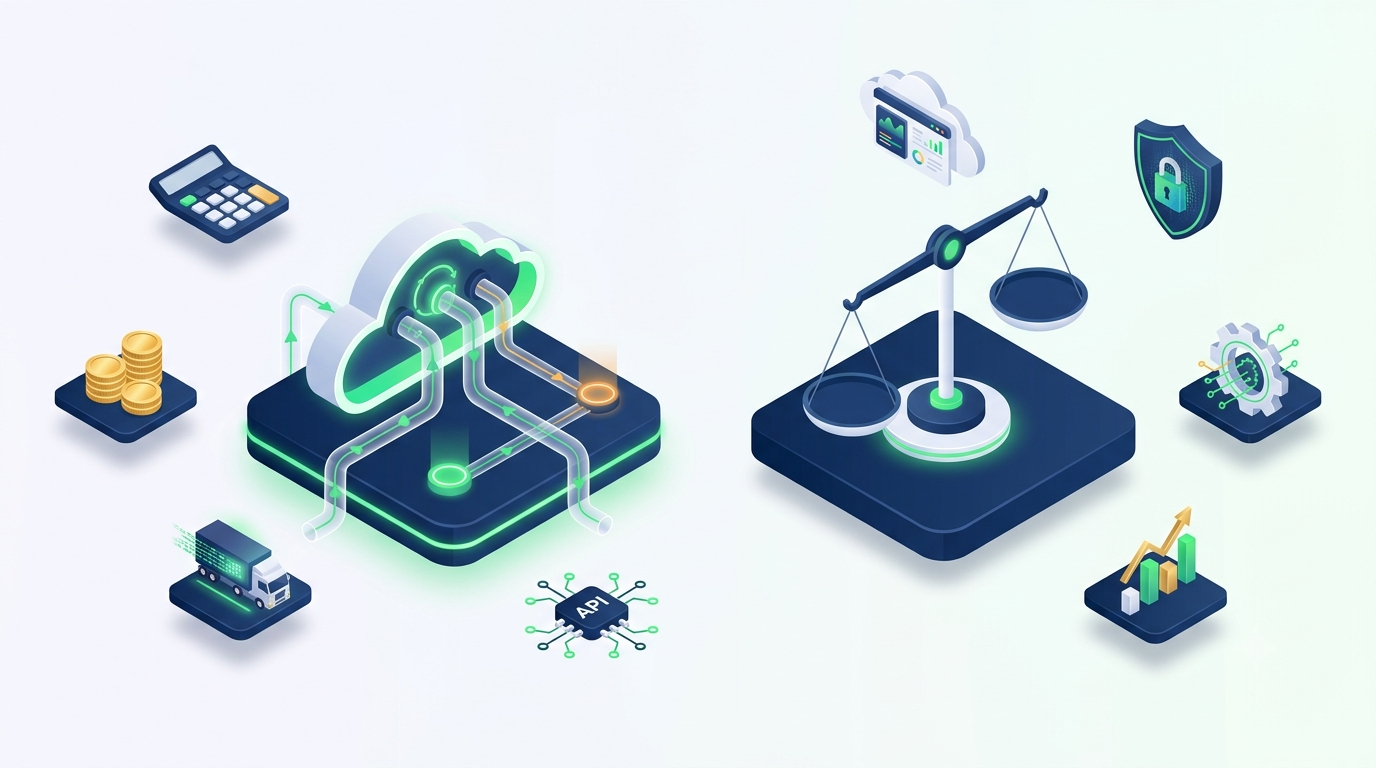
When several applications need to communicate, connecting every system directly to every other system can become difficult to maintain. We can build an integration layer that becomes the central point for moving, transforming and synchronizing operational data.
Integration Layer
Synchronization
Integration isn't only about sending data once. Businesses often need information to remain synchronized as records change. The model — one-way, two-way, scheduled, real-time or event-triggered — depends on the technical requirements.
Reliability
Integrations need to be reliable. Failed API calls or missing data shouldn't silently disappear.
Custom APIs
When you control the underlying software but it doesn't currently expose the functionality required by another application, we can design and develop custom APIs around your system.
Existing Internal Software
Custom REST API
If a third-party system has no API or technical access, we evaluate what is actually possible rather than promising a connection that the vendor does not support.
Discovery
You don't need to come to us with an API specification. Show us the software your operation currently uses and the manual steps your team performs between them. We'll map the workflow and identify where integrations or automation could remove repetitive work.
Today
Tomorrow
We identify the systems involved, the data your team currently moves manually and the desired outcome.
We evaluate available APIs, webhooks, documentation, authentication methods and technical limitations.
We determine how entities such as drivers, trucks, loads, customers, documents or invoices correspond between systems.
We develop APIs, middleware, synchronization jobs or event-based workflows.
We validate normal operations, duplicate records, failed requests, authentication issues and other edge cases.
The integration is deployed with appropriate logging and monitoring.
Additional systems and workflows can be integrated over time.
Security
Logistics integrations often move operational and business-sensitive information between multiple platforms. We design integrations with appropriate authentication, permissions, encrypted connections and controlled access based on the systems involved.
OAuth where supported
Secure API keys
Role-based access
HTTPS / TLS
Logging
Secure secret management
Security controls are scoped to the platforms in the project. We don't claim independent certifications unless they are part of a specific engagement.
Who this is for
Connect dispatch, telematics, fuel, accounting and driver systems.
Connect TMS, carriers, customer portals, accounting and shipment tracking.
Integrate job management, routing, driver apps, customer notifications and billing.
Connect WMS, inventory, transportation and customer systems.
Integrate ERP, purchasing, warehouses, transportation and analytics.
Build API integrations between your software and third-party logistics platforms.
Integrate vs replace
| Replace Everything | Integrate Existing Systems |
|---|---|
| Large migration | Keep familiar tools |
| Retrain teams | Minimal workflow disruption |
| Move historical data | Connect existing data |
| Higher initial scope | Solve specific bottlenecks |
| Replace working features | Preserve what already works |
Replace Everything
Large migrationIntegrate Existing Systems
Keep familiar toolsReplace Everything
Retrain teamsIntegrate Existing Systems
Minimal workflow disruptionReplace Everything
Move historical dataIntegrate Existing Systems
Connect existing dataReplace Everything
Higher initial scopeIntegrate Existing Systems
Solve specific bottlenecksReplace Everything
Replace working featuresIntegrate Existing Systems
Preserve what already worksSometimes the operational problem isn't that your company lacks software. It's that you have five good systems that don't communicate.
If your current applications already perform their individual jobs well, integration can often be a more practical first step than replacing your entire technology stack.
Why Tvareet
An API connection is only useful when it solves an operational problem.
Tvareet combines software-development experience with an understanding of logistics workflows across transportation, fleet management, dispatch, drivers, fuel and supply chain operations.
APIs
Node.js / TypeScript APIs
Interfaces
REST APIs
Events
Webhooks
Real-time
Real-time communication
Sync
Data synchronization
Architecture
Middleware development
Cloud
Cloud infrastructure
Partners
Third-party integrations
Using a TMS, Samsara, fuel cards, accounting software, spreadsheets or internal systems that require constant manual updates? Show us the workflow and we'll help determine whether an API integration, automation or custom middleware layer can connect it.
Get a Free Integration Review. Send us the names of the systems you're currently using and what your team manually moves between them. Prefer a scoped conversation?Discuss Your Integration Project.
TMS, Samsara and Geotab, fuel cards, QuickBooks, real-time sync, failed jobs, middleware and cost.
Let's connect
Connect the software you already use and automate the workflows between them.