Uber Freight didn't just build a logistics app. It dismantled a $800 billion industry's dependence on phone calls, fax machines, and broker middlemen — and replaced it with a platform where shippers get instant pricing and carriers find loads in seconds.
The result? Uber Freight now manages over $20 billion in freight annually, processing more than 24 million loads across 6,000 brands. And every logistics business, freight startup, and carrier network watching from the sidelines is asking the same question: how much would it cost to build something like that?
The honest answer is: it depends. But "it depends" isn't useful when you're trying to build a business case or scope a budget. So in this guide, we're going to give you real numbers, real breakdowns, and the specific factors that move the cost needle — so you can walk into any development conversation fully informed.
We'll cover what Uber Freight actually built, the features that define a competitive logistics app in 2026, a realistic cost breakdown from MVP to enterprise, the tech stack required, development timelines, and the questions every buyer should ask before signing a development contract.
At Tvareet, we've built freight management systems and logistics platforms for carriers, forwarders, and logistics startups across the UAE, Australia, and globally. The cost and timeline figures in this guide are based on our real project data — not generic research reports or inflated agency estimates. If you want a number specific to your requirements, we offer a free project scoping consultation at the end of this guide.
📊 Market Context The global digital logistics market is projected to reach $46.5 billion by 2026 with a CAGR of 21.7%. The freight matching market alone is forecast to exceed $766 billion by 2034. In the US, the trucking industry generates over $260 billion in annual revenue — and over 60% of logistics companies are still struggling with manual processes. The opportunity window for a well-built freight app has never been wider. |
What Is Uber Freight? How the Platform Works in 2026
Uber Freight is a digital freight brokerage platform — essentially the Uber model applied to trucking. It connects shippers (businesses that need to move cargo) with carriers (truck drivers and fleet operators) through a mobile and web platform that handles everything from instant quoting and load matching to real-time tracking, digital documentation, and automated payments.
Launched in 2017, Uber Freight disrupted the traditional freight brokerage model by removing the human broker from the transaction. Instead of a shipper calling a broker, who calls five carriers, who faxes back rates, Uber Freight's platform delivers upfront pricing in seconds and matches loads to available carriers automatically using AI-powered algorithms.
By 2026, Uber Freight had evolved well beyond a simple load board. Their platform now includes:
A full Transportation Management System (TMS) with financial management, order-to-cash tracking, and AI-powered dispute resolution
Uber Freight Exchange — a contract and spot freight procurement platform connecting shippers directly with carrier networks
Insights AI — an AI layer that answers over 2,000 logistics questions using data from millions of historical shipments
Uber Direct integration — connecting ground freight with last-mile delivery through Uber's driver network
Parcel TMS — which has processed over 250 million packages
Understanding what Uber Freight built over eight years and hundreds of millions in investment is important context for what you're actually building — and why the cost range for a serious logistics platform starts much higher than most agencies will tell you.
Types of Logistics Apps Like Uber Freight You Can Build
Before diving into costs, it's critical to define what type of logistics app you're actually building. "An app like Uber Freight" means different things to different businesses, and the cost swings dramatically based on scope.
Digital Freight Marketplace (Uber Freight Model)
A two-sided marketplace connecting shippers and carriers. Includes separate apps for shippers, drivers, and an admin dashboard. This is the most complex and expensive type to build correctly — but also the highest-value model commercially. Cost range: $50,000 to $150,000+.
On-Demand Trucking App
A more focused version of the marketplace model — typically targeting a specific geography, cargo type, or transport mode. Think Uber for last-mile delivery, refrigerated transport, or heavy haulage within a single city or region. Cost range: $30,000 to $80,000.
Freight Management System with Mobile App
An internal operations platform for a logistics company or carrier — not a public marketplace, but a proprietary system to manage their own shipments, drivers, and customers. Mobile app is a component, not the core product. Cost range: $30,000 to $80,000.
Fleet Management App
Driver-facing tools for GPS tracking, route optimization, vehicle diagnostics, and proof of delivery. Often built as a component of a larger logistics platform. Standalone cost range: $25,000 to $75,000.
Freight SaaS Product
A multi-tenant commercial product built for logistics businesses to subscribe to — similar to Uber Freight but sold as a platform to other forwarders, 3PLs, or carriers. This is the most complex model, requiring multi-tenancy, white-labeling, subscription billing, and enterprise-grade security. Cost range: $80,000 to $200,000+.
Key Features of a Logistics App Like Uber Freight
A competitive logistics app in 2026 is built around three distinct panels — Shipper App, Carrier/Driver App, and Admin Dashboard. Each has its own feature set and its own development cost contribution.
Shipper App Features
Registration & profile management with business verification
Shipment creation — pickup/dropoff locations, cargo type, weight, dimensions, special handling
Instant freight rate calculation with transparent pricing breakdown
AI-powered carrier matching — best carrier based on price, transit time, and performance history
Real-time GPS shipment tracking with live map view and ETA updates
Digital documentation — bills of lading, invoices, customs docs, proof of delivery
Secure in-app payment with multiple gateway support and invoice management
Automated push notifications — booking confirmations, status updates, delays, delivery confirmation
Shipment history, analytics, and spend reporting dashboard
In-app messaging with assigned carrier/driver
Ratings and reviews for completed shipments
Carrier / Driver App Features
Carrier onboarding with document verification — insurance, operating authority, vehicle docs
Driver profile with license, vehicle, and availability management
Load discovery — browse, filter, and search available loads by location, weight, and pay
Instant booking and conditional bidding on available freight
Turn-by-turn route navigation with real-time traffic and route optimization
Live GPS broadcasting for shipper and admin visibility
Digital proof of delivery — photo capture, e-signature, timestamp
Earnings dashboard — completed loads, pending payments, payout history
In-app chat with shipper for pickup coordination
Performance scorecard and ratings management
Admin Dashboard Features
Full user management — shippers, carriers, drivers — with verification and approval workflows
Shipment monitoring — real-time visibility across all active loads on the platform
Dynamic pricing controls — commission rates, surge pricing, minimum rates by lane
Dispute resolution and issue management tools
Payment and commission management — automated payouts to carriers, revenue tracking
Fraud detection and platform compliance monitoring
Analytics and reporting — GMV, load completion rates, carrier utilization, platform health KPIs
Push notification and communication management
Content management for app content, FAQs, and onboarding flows
Advanced / AI Features (Scale-Up Phase)
AI-powered load matching algorithm — learns from historical data to improve carrier-shipper fit
Predictive pricing engine — adjusts rates based on demand, fuel prices, and lane supply
Route optimization engine — reduces empty miles, fuel cost, and transit time
Automated document extraction — AI reads carrier emails and PDFs to extract rate and booking data
Demand forecasting — predicts freight volume spikes by lane and season
Intelligent dispute resolution — AI pre-screens invoice discrepancies before human review
✅ Must-Have Features for 2026 Competitiveness Based on where the market is in 2026, any logistics app entering the market needs at minimum: real-time GPS tracking, AI-powered load matching, instant upfront pricing, digital proof of delivery, in-app payments, and automated notifications. These are table stakes — not differentiators. Your competitive advantage needs to come from UX quality, niche focus, geographic targeting, or a specific operational workflow your competitors haven't solved. |
Uber Freight App Development Cost Breakdown (2026)
Here is a realistic, research-based cost breakdown for building a logistics app like Uber Freight in 2026. These figures reflect end-to-end delivery — discovery, design, development, testing, integrations, and go-live — with a South/Southeast Asian development team at $25–$50/hour, which delivers the best cost-to-quality ratio for this type of product.
Build Type | What's Included | Timeline | Estimated Cost |
MVP / Starter | Core shipper + driver app, basic load matching, GPS tracking, in-app payments, admin panel | 3–5 months | $20,000 – $60,000 |
Mid-Level Platform | Full feature set, AI matching, real-time analytics, document management, multi-payment | 5–9 months | $70,000 – $130,000 |
Enterprise Platform | AI pricing, predictive analytics, ERP/TMS integrations, multi-region, white-label ready | 9–18 months | $100,000 – $200,000+ |
SaaS / Commercial Product | Multi-tenant, subscription billing, white-labeling, enterprise API, full analytics suite | 10–18 months | $150,000 – $300,000+ |
Note: North American and Western European development teams bill $80–$150/hour, which can 2–3x these figures for equivalent scope. Hybrid team models (senior architects in your timezone, execution team offshore) offer a good balance of cost and communication quality.

Feature-by-Feature Cost Breakdown
If you're building incrementally or trying to understand where budget goes, here is a module-level cost estimate:
Feature Module | Estimated Development Cost |
User onboarding & authentication (both apps) | $5,000 – $10,000 |
Shipment creation & booking workflow | $8,000 – $15,000 |
Real-time GPS tracking & mapping | $10,000 – $20,000 |
AI-powered load matching algorithm | $15,000 – $30,000 |
Dynamic pricing engine | $12,000 – $25,000 |
In-app payments & payouts | $8,000 – $18,000 |
Digital documentation (BOL, POD, invoices) | $7,000 – $14,000 |
Push notifications & in-app messaging | $5,000 – $10,000 |
Admin dashboard (full) | $15,000 – $30,000 |
Analytics & reporting module | $8,000 – $18,000 |
Carrier onboarding & verification | $6,000 – $12,000 |
Route optimization engine | $12,000 – $22,000 |
Third-party API integrations (ERP, TMS, maps) | $10,000 – $25,000 |
Key Factors That Affect Your Total Development Cost
Two logistics apps with similar feature lists can have dramatically different price tags. Here are the six factors that most significantly move the cost needle:
Development Team Location
This is the single biggest cost variable. Hourly rates by region in 2026:
Region | Hourly Rate Range | Best For |
North America / Western Europe | $80 – $150/hr | Highest quality assurance, easiest communication |
Eastern Europe | $50 – $90/hr | Strong technical depth, good timezone overlap with Europe |
India / South Asia | $25 – $50/hr | Best cost-to-quality ratio for logistics apps at scale |
Southeast Asia | $30 – $55/hr | Growing logistics tech expertise, competitive pricing |
Latin America | $40 – $80/hr | Good for US-timezone aligned projects |
App Complexity and Feature Scope
Every advanced feature adds development hours. AI load matching is 3–4x more complex to build than basic manual matching. Real-time GPS tracking requires WebSocket infrastructure, map API licensing, and continuous server load. Dynamic pricing engines need machine learning models trained on historical data. The deeper your feature set, the longer the build.
Platform Choice — Native vs Cross-Platform
Building native iOS and Android apps separately produces the best performance but costs 40–60% more than cross-platform development using React Native or Flutter. For most logistics startups and growth-stage companies, React Native or Flutter delivers sufficient performance at meaningfully lower cost. Enterprise platforms with very high real-time data loads may benefit from native development for the driver app specifically.
Third-Party Integrations
Every external integration adds cost. Google Maps or Mapbox for GPS adds licensing and implementation cost. Payment gateways (Stripe, PayPal, local gateways) require secure implementation and PCI compliance. ERP and TMS integrations can add $10,000–$25,000 each depending on the platform. Plan your integration list carefully — every connection is a cost and a maintenance obligation.
UX/UI Design Quality
In a marketplace app, design directly impacts carrier and shipper retention. Poor UX means carriers abandon loads, shippers abandon bookings, and your platform bleeds users before it achieves network density. Professional UX research, wireframing, prototyping, and polished UI design typically adds $5,000–$10,000 to a project budget — and it's one of the highest-ROI investments you can make in a marketplace product.
Post-Launch Maintenance and Scaling
Most businesses underbudget for post-launch costs. After go-live, expect to spend 15–20% of your initial development cost annually on maintenance, bug fixes, OS compatibility updates, security patches, and feature development. Cloud infrastructure costs for a live logistics app with real users typically run $500–$5,000 per month depending on load. Build this into your 3-year financial model.
Technology Stack Required to Build an App Like Uber Freight
Choosing the right technology stack determines not just how your app performs today, but how it scales as your user base and data volumes grow. Here is the recommended tech stack for a production-grade logistics app in 2026:
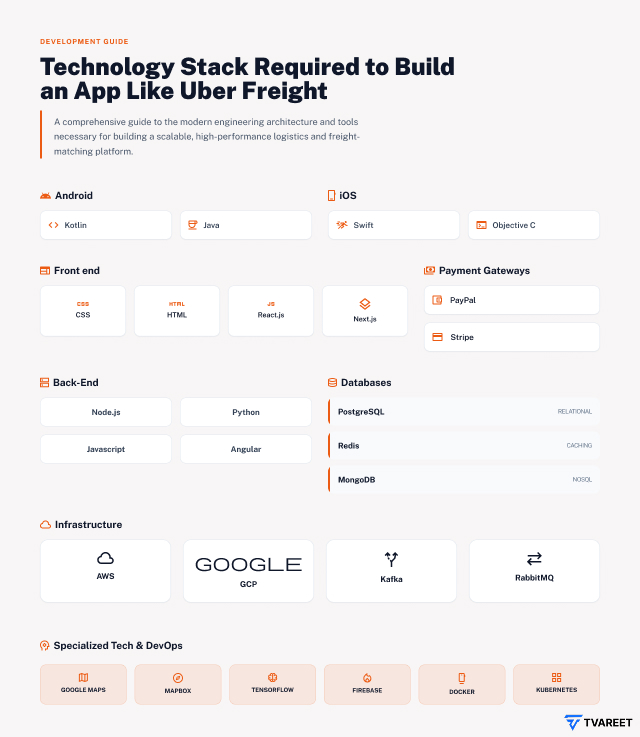
⚡ Architecture Principle Build your logistics app on a microservices architecture from day one if you're planning for scale. The GPS tracking service, load matching engine, payment processor, and notification system should each be independently deployable and scalable. This prevents a single high-load component (like real-time tracking during peak hours) from degrading the rest of your platform. |
Development Timeline — What to Expect
Timeline varies significantly based on team size, feature scope, and how quickly your stakeholders can make product decisions. Here is a realistic phase-by-phase timeline for a mid-level logistics app build:
Phase | Activities | Duration |
Discovery & Planning | Requirements gathering, competitor analysis, technical architecture, project roadmap | 2–3 weeks |
UX/UI Design | User journey mapping, wireframes, interactive prototypes, design system | 3–5 weeks |
MVP Development | Core shipper app, driver app, admin panel, basic matching and GPS | 8–12 weeks |
Advanced Features | AI matching, dynamic pricing, analytics, document management | 6–10 weeks |
Integrations & Testing | API integrations, load testing, UAT, security audit | 3–5 weeks |
Deployment & Go-Live | Production deployment, go-live support, team training | 1–2 weeks |
Post-Launch Iteration | User feedback integration, performance optimization, feature additions | Ongoing |
Total timeline for a mid-level platform: approximately 5 to 9 months from kickoff to go-live. Enterprise builds with extensive integrations and AI capabilities: 9 to 18 months.
Monetization Models — How to Make Money
Before building, define your revenue model. It directly affects which features you need at launch and how you design your platform economics.
Commission-Based Model
The most common model for freight marketplaces. Take a percentage (typically 10–20%) of every completed shipment booked through your platform. Uber Freight uses this model as a base. Pros: scales with volume. Cons: requires significant load volume to generate meaningful revenue.
Subscription / SaaS Model
Charge carriers or shippers a monthly fee for platform access, with tiered plans based on usage volume or feature access. Works well for platforms targeting a defined user base — for example, a fleet management tool sold to carriers on a per-truck subscription.
Freemium + Premium Features
Offer basic load matching for free to grow your network quickly, then charge for premium features like priority placement, advanced analytics, or dedicated account management. Effective for growing marketplace liquidity in early stages.
Data & Analytics Sales
As your platform accumulates shipment data across lanes, carriers, and commodities, that data becomes commercially valuable. Anonymized freight rate and volume data can be sold to shippers, financial institutions, and logistics analysts. Uber Freight's Insights AI product is partly built on this monetization layer.
Advertising & Partnerships
In-app advertising from fuel providers, insurance companies, and equipment vendors targeted at carriers. Works as a supplementary revenue stream once you have a substantial carrier base.
9. Build vs. Buy vs. White-Label: Which Path Is Right for You?
Not every business should build from scratch. Here is an honest breakdown of your three options:
Approach | Cost | Time to Market | Customization | Best For |
White-Label Clone | $5,000 – $30,000 | 2–8 weeks | Very Limited | Testing concept, micro-budget startups |
Off-the-Shelf TMS + App | $20,000 – $80,000/yr | 4–12 weeks | Moderate | Established logistics ops needing digital tools |
Custom Build (MVP) | $60,000 – $100,000 | 3–5 months | Full | Startups with product-market fit validation |
Custom Build (Full) | $150,000 – $300,000+ | 6–18 months | Full | Serious freight platforms and SaaS products |
White-label clone scripts can get something live quickly but they carry significant technical debt, poor scalability, and zero competitive differentiation. If you're building a real freight business — not testing a concept — custom development is the only path to a defensible product.
How to Reduce Logistics App Development Cost Without Cutting Quality
Building a logistics app is a significant investment. Here are five legitimate ways to reduce cost without cutting corners on the features that matter:
Start with a focused MVP — don't try to build everything Uber Freight has in version 1. Define the one workflow you need to validate first (load matching, or tracking, or payments) and build that exceptionally well.
Choose cross-platform mobile development — React Native or Flutter saves 30–50% on mobile development compared to building separate native iOS and Android apps without meaningful performance sacrifice for most logistics use cases.
Use managed cloud services — AWS RDS, Google Cloud Run, and Firebase reduce the backend infrastructure you need to build and maintain from scratch. Leverage managed services before building custom infrastructure.
Leverage open-source mapping — OpenStreetMap with a self-hosted routing engine (OSRM or Valhalla) can replace Google Maps API for many logistics use cases at a fraction of the licensing cost, especially at high transaction volumes.
Build a hybrid team — use senior architects and product managers in your timezone for strategy and decision-making, paired with an experienced offshore development team for execution. This combination delivers good quality at 40–60% of the cost of a fully onshore team.
FAQ’s
1. How much does it cost to build an app like Uber Freight in 2026?
A: A realistic MVP — with shipper app, driver app, basic load matching, GPS tracking, and payments — costs between $60,000 and $100,000. A mid-level platform with AI matching, analytics, and full document management runs $100,000 to $180,000. An enterprise-grade platform comparable to what Uber Freight operates today costs $200,000 to $300,000 or more. Agencies quoting $10,000–$30,000 for a full Uber Freight equivalent are referring to template clones, not production-ready custom platforms.
2. How long does it take to build a logistics app like Uber Freight?
A: An MVP can be delivered in 3 to 5 months with a focused team. A mid-level platform with AI features and integrations typically takes 5 to 9 months. Enterprise platforms with multi-region deployment, ERP integrations, and full AI capabilities require 9 to 18 months. Timeline is heavily influenced by the speed of stakeholder decisions, scope changes during development, and the complexity of third-party integrations.
3. What features are essential for a logistics app MVP?
A: The minimum viable feature set for a competitive logistics app in 2026 includes: user registration and verification for both shippers and carriers, shipment creation and booking, real-time GPS tracking, automated carrier matching, in-app payments, digital proof of delivery, push notifications, and an admin dashboard. AI-powered pricing and advanced analytics are scale-up features — important, but not required for an MVP.
4. Should I build native apps or use React Native / Flutter?
A: For most logistics apps, React Native or Flutter is the right choice. They deliver cross-platform functionality from a single codebase, reducing development cost by 30–50% compared to building separate iOS and Android native apps. The exception is driver apps with extremely intensive background GPS requirements — some platforms find native Android performs more reliably for continuous high-frequency GPS tracking. A hybrid approach (React Native for shipper app, native for driver) is a legitimate architecture for high-scale platforms.
5. How does a logistics app like Uber Freight make money?
A: The primary model is commission-based — taking a percentage (typically 10–20%) of every completed shipment booked through the platform. Additional revenue streams include carrier and shipper subscriptions for premium features, in-app advertising from logistics-adjacent businesses, data analytics products sold to shippers and enterprises, and value-added services like cargo insurance and fuel cards offered through partner integrations.
6. What is the ongoing maintenance cost after launch?
A: Plan for 15–20% of your initial development cost annually in maintenance. For a $100,000 build, that's $15,000–$20,000 per year covering bug fixes, OS updates, security patches, and minor feature improvements. Cloud hosting and infrastructure costs for a live platform with active users typically run $500–$5,000 per month depending on transaction volume and geographic reach. Factor these costs into your business model from day one.
7. Can I build a multi-country logistics platform from the start?
A: Technically yes, but strategically it's usually the wrong move. Multi-country deployment requires multi-currency payment processing, localized carrier and regulatory compliance, geographically distributed infrastructure, and a carrier network in each market. These requirements add significant cost and complexity. Most successful freight platforms launched in a single city or corridor, achieved density, and then expanded. Build for one market first — expand when you have product-market fit.
8. What is the difference between a freight marketplace app and a fleet management app?
A: A freight marketplace (like Uber Freight) is a two-sided platform connecting shippers with external carriers — it's a B2B marketplace business. A fleet management app is an operational tool for a logistics company to manage their own vehicles, drivers, and deliveries. They serve different business models and have different feature requirements. Many logistics companies build fleet management tools first, then layer marketplace functionality on top once their technology foundation is established.
9. How do I validate my logistics app idea before investing in full development?
A: Before committing to a full build, validate with three steps: conduct 15–20 in-depth interviews with shippers and carriers in your target market to confirm the pain points your app solves. Build a simple landing page describing the product and run paid ads to measure conversion interest. Then build the most critical single workflow as an MVP — load posting and matching, for example — and test it with 5–10 real users before expanding scope. This validation process typically costs $5,000–$15,000 and can save you from a $100,000 pivot.
Why Logistics Businesses Choose Tvareet to Build Their Freight App
Many development agencies can write code for a logistics app. Very few understand how freight actually works — the pricing structures, carrier relationships, documentation requirements, and operational realities that determine whether a logistics platform succeeds or fails in the real world. Here's what makes Tvareet different:
Freight Domain Expertise Built Into Every Project
Our team includes logistics domain specialists who've worked inside freight forwarding operations — not just developers who've read about them. That domain knowledge gets embedded into your system's architecture, your UX flows, and your carrier integration design from day one. The result is a platform that feels like it was built by people who understand freight, because it was.
Pre-Built Carrier Integration Frameworks
We have pre-built integration frameworks for major ocean, air, and road carriers including Maersk, DHL, FedEx, and major regional carriers across the UAE and Australia. Integrations that take a generalist team 4–6 weeks take us 1–2 weeks. You get faster time-to-market and more thoroughly tested carrier connections from day one.
UAE and Australia Market Knowledge
We understand the local carrier networks, regulatory environments, and logistics workflows specific to the UAE/GCC and Australian markets — the two geographies where most of our clients operate. If you're building a freight app for either of these markets, that local knowledge is a significant advantage in getting your platform right.
Transparent Milestone-Based Delivery
You see working software every two weeks — not after six months of development with no visibility. Clear milestones, honest communication, and no scope surprises. If something needs to change, we tell you early when it's still affordable to fix.
Long-Term Partnership, Not One-Off Projects
Over 70% of our freight clients retain Tvareet after go-live for ongoing feature development, carrier API maintenance, and infrastructure scaling. We're not interested in delivering a product and disappearing — we build long-term technology partnerships with logistics businesses that are serious about their platforms.
Key Takeaways
A production-ready logistics app like Uber Freight costs $60,000–$100,000 for an MVP and $150,000–$300,000+ for a full enterprise platform — not the $10,000–$30,000 figures often quoted online.
The three core components are the Shipper App, Carrier/Driver App, and Admin Dashboard — each with distinct features and development costs.
Development team location is the single biggest cost variable — South/Southeast Asian teams deliver the best cost-to-quality ratio for logistics platforms.
AI-powered load matching, real-time GPS tracking, dynamic pricing, and digital proof of delivery are the must-have features for competitive differentiation in 2026.
Choose React Native or Flutter for mobile to save 30–50% versus native development without sacrificing meaningful performance for most logistics use cases.
Start with a focused MVP, validate with real users, then scale — don't attempt to build everything Uber Freight has in version 1.
Budget 15–20% of development cost annually for post-launch maintenance and plan for $500–$5,000/month in cloud infrastructure costs.