
Your dispatch team is still coordinating same-day deliveries through WhatsApp groups and whiteboards. Your customers are refreshing their inbox for tracking updates that arrive six hours late. And the development agency you spoke to last week said they could "wrap it up in twelve weeks" without asking a single question about your driver payment workflow. If you are a logistics manager or operations director, you already know that building a courier app is not a coding exercise. It is a structural overhaul of how your business moves goods, communicates with customers, and settles accounts. Without a realistic timeline, you are not buying software. You are buying a delay.
In this post, we are going to walk through exactly how a professional logistics software development team plans, builds, and ships a courier application. You will see real timelines, exact cost ranges for specific features, and a B2B case study that shows how the right process saves both money and reputation. Whether you are building a last-mile delivery platform for e-commerce partners or a white-label courier solution for regional carriers, you need a timeline that accounts for complexity, integration, and human behavior. Let us get into the specifics.
Why Most Courier App Timelines Collapse in the First Month
Most failed builds start with a request for a "simple tracking app" and end with a product that drivers refuse to use. The gap between those two points is almost always a missing discovery phase. Courier operations are not generic. A driver in a dense urban zone operates differently from a rural route. A pharmacy delivery requires temperature logging. A B2B freight handoff requires Bills of Lading that match your client's ERP format. These are not add-ons. They are baseline requirements.
When you commission custom logistics software, the first four weeks should be dedicated to operational archaeology. Business analysts need to ride along with drivers. They need to sit with dispatchers during peak hours. They need to understand how your finance team reconciles cash-on-delivery payments at the end of a shift. This discovery phase is where your shipment creation and booking workflow is mapped. It is where you learn that a two-tap booking interface is not a luxury for your customers; it is a conversion requirement. It is where you identify that your proof-of-delivery process must capture a photo, a signature, and a geotag because your largest client rejects invoices without all three.
Skipping this phase produces a brittle timeline. You discover the gaps during user acceptance testing, when fixing them costs ten times more than fixing them in a wireframe. A professional timeline treats weeks one through four as non-negotiable. They are not "project kickoff." They are the foundation of your entire architecture. During this window, the team also audits your existing supply chain management tools. If your warehouse uses a specific WMS, your app needs to inherit its data schema for shipment handoffs. If your finance team relies on an older accounting package, the invoice format in your digital documentation module must match. These details do not make exciting features. They make the difference between software that works and software that embarrasses you in front of your biggest client.
The Real-World Courier App Development Timeline
Let us walk through exactly what happens, week by week, in a build that actually ships. This is not a theoretical ideal. It is the schedule that experienced logistics software development teams follow when they are building for production scale.
Phase 1: Discovery and Technical Architecture (Weeks 1–4)
The team interviews stakeholders, maps the package lifecycle, and selects the tech stack. For courier apps, the backend must handle high-frequency GPS writes. A relational database might work for your inventory, but a courier app often needs a time-series or geospatial component to process location streams without lag. During this phase, the team also audits your existing software ecosystem. If your warehouse uses a specific WMS, your app needs to inherit its data schema for shipment handoffs. This phase ends with a functional specification document, user stories for every persona, and a system architecture diagram.
Phase 2: UI/UX Design and Prototyping (Weeks 5–8)
Design for courier apps is not about aesthetics. It is about survival. A driver standing in rain with a cracked screen needs oversized buttons and zero ambiguity. A dispatcher managing forty exceptions needs density without clutter. The design team produces clickable prototypes for every major flow: customer booking, driver assignment, delivery confirmation, and exception reporting. These prototypes are tested with real users. If a driver cannot complete a pickup flow in under eight seconds while holding a package, the design fails. This phase catches those failures before they are cemented in code.
Phase 3: Backend Development and Core APIs (Weeks 9–14)
The backend is built first. This includes the user onboarding and authentication system ($5,000 – $10,000). It is not just login screens. It is role-based access control separating customers, drivers, dispatchers, and finance admins. It is the carrier onboarding and verification module ($6,000 – $12,000) if you work with third-party drivers. It is the shipment creation and booking workflow API ($8,000 – $15,000), which must handle concurrent booking requests without deadlocking your inventory. The team also builds the core tracking event pipeline, the notification engine, and the payment ledger architecture.
Phase 4: Mobile Apps and Driver Experience (Weeks 15–22)
The mobile team builds the driver app and the customer-facing tracking interface. The driver app is the more complex build. It requires real-time GPS tracking and mapping ($10,000 – $20,000). This is not just dropping a pin on a map. It is managing battery-efficient location polling, handling signal loss in parking garages, and translating coordinates into human-readable addresses for customer SMS updates. The app also needs digital documentation ($7,000 – $14,000) for proof-of-delivery. This module must work offline. If a driver loses signal at a warehouse basement, the app queues the signature capture and syncs when connectivity returns. The customer app is built in parallel, focused on clean tracking visualization and booking flows.
Phase 5: Admin Dashboard and Operational Control (Weeks 23–28)
The admin dashboard (full) ($15,000 – $30,000) is the nerve center. Dispatchers live here. They need to see every active driver, assign new orders with drag-and-drop speed, and handle exceptions. A delivery exception could be a wrong address, a refused package, or a vehicle breakdown. The dashboard must surface these alerts with context, not just red dots. The route optimization engine ($12,000 – $22,000) is also integrated here. It ingests all active orders, traffic data, and vehicle constraints to suggest the most efficient routes. For a fleet doing two thousand stops a week, a ten percent efficiency gain pays for this module in under three months. The analytics and reporting module ($8,000 – $18,000) is wired to every data stream. It generates on-time performance reports, driver utilization heatmaps, and revenue per route.
Phase 6: QA, UAT, and Field Pilot (Weeks 29–34)
You cannot test a courier app in an office. The QA team runs automated test suites for API stability and load testing. Then the app goes into a field pilot. Drivers use it on real routes. Dispatchers manage real orders. The team discovers that the barcode scanner struggles with reflective labels. They discover that the push notification ($5,000 – $10,000) timing is off, alerting customers before the driver has actually left the warehouse. These are not bugs in the traditional sense. They are operational mismatches. Fixing them now prevents a one-star review storm at launch.
Phase 7: Deployment and Launch Stabilization (Weeks 35–38)
The app is submitted to stores. The production backend is scaled. The team monitors crash analytics, server latency, and payment success rates with obsessive attention. Most courier apps need a two-week stabilization window after public launch. This is where you catch the edge cases that only appear at scale: a driver in a timezone you had not tested, a payment processor rejecting a specific card type, a map API returning bad data for a new subdivision. You plan this buffer into your timeline, or you plan a public failure.
In total, you are looking at a thirty-six to forty-week timeline from discovery to stable production for a fully featured courier platform. If an agency promises you six months, they are either selling you a template or they have not understood your requirements. If they promise three months, run.
Where the Money Goes: A Feature-by-Feature Cost Breakdown
Every feature in a courier app exists to solve a specific operational problem. Here is how the budget breaks down, using only the exact cost ranges for features relevant to this build.
User Onboarding & Authentication ($5,000 – $10,000)
This covers registration, login, password recovery, and role-based access. For courier apps, you often have three distinct portals: a consumer booking app, a driver app, and an admin console. Each needs its own authentication flow and permission layer. If you plan to scale to white-label clients later, this layer must support multi-tenant access from the start.
Carrier Onboarding & Verification ($6,000 – $12,000)
If your platform uses third-party drivers or independent contractors, you need document upload, background check API integration, and approval workflows. This is essential for liability and compliance. The verification workflow must also integrate with the driver app, blocking unapproved users from accepting orders until their file is cleared.
Shipment Creation & Booking Workflow ($8,000 – $15,000)
The core commercial engine. This is the customer-facing interface where orders are born. It must validate addresses, calculate dimensional weight, schedule pickups, and pass structured data to the dispatch system. If your model supports on-demand courier requests, this workflow must trigger immediate driver assignment logic without manual dispatcher intervention.
Real-Time GPS Tracking & Mapping ($10,000 – $20,000)
This covers the integration of mapping SDKs, geocoding services, and the backend infrastructure that receives, stores, and broadcasts location events. It must be built for scale. A hundred drivers pinging every five seconds generates serious server load. The system must also translate raw coordinates into street addresses for automated customer notifications.
Route Optimization Engine ($12,000 – $22,000)
Algorithmic logic that turns a list of stops into an efficient sequence. It accounts for traffic, delivery windows, vehicle capacity, and driver shift limits. This module sits between the dispatch system and the driver's navigation. For a courier fleet, this is a profit lever. A ten percent efficiency gain on fuel and driver time often pays for the entire module within a single quarter.
Dynamic Pricing Engine ($12,000 – $25,000)
If your rates fluctuate by distance, weight, time of day, or demand, you need this engine. It calculates quotes in real time, locks prices at booking, and feeds margin data to your reporting module. The engine must also handle surge rules gracefully, so customers see predictable prices even when demand spikes.
In-App Payments & Payouts ($8,000 – $18,000)
This covers customer payment processing, platform fee logic, and automated driver payouts. It requires PCI compliance, escrow handling for disputed deliveries, and reconciliation reporting. The payout logic is particularly sensitive. If a driver taps "confirm delivery" twice because of a slow connection, the system must not double-pay them. This requires idempotent transaction processing.
Digital Documentation (BOL, POD, Invoices) ($7,000 – $14,000)
Proof-of-delivery is your legal protection. This module captures signatures, photos, timestamps, and geotags. It generates PDF invoices and Bills of Lading. It must handle failed delivery documentation when a recipient is absent. For B2B courier services, these documents often need to sync directly with your client's ERP, so the format must match their expectations exactly.
Push Notifications & In-App Messaging ($5,000 – $10,000)
The communication layer. Customers get "driver is ten minutes away" alerts. Drivers get new order assignments. Dispatchers broadcast weather delays. This is not just a feature. It is your primary customer service channel. A well-timed notification reduces "where is my order" calls by over half in most deployments.
Admin Dashboard (Full) ($15,000 – $30,000)
The largest single frontend investment. Order management, live fleet map, exception handling, user management, and configuration panels. A thin dashboard forces you to hire more dispatchers as you scale. A robust dashboard lets you scale without adding headcount. This is where [transport management system development] overlaps with courier app development. If your admin console is built with the right data architecture, it can become the nucleus of a broader TMS over time.
Analytics & Reporting Module ($8,000 – $18,000)
Business intelligence for your operations. On-time delivery rates, cost per mile, driver scorecards, and customer satisfaction tracking. This turns raw operational data into strategic decisions. It is also the module that justifies your ROI when you present results to stakeholders six months after launch.
AI-Powered Load Matching Algorithm ($15,000 – $30,000)
For platforms that match third-party drivers to available loads, this algorithm analyzes proximity, capacity, historical performance, and customer preferences to suggest assignments. It reduces dead miles and increases driver earnings. For platforms scaling past one hundred active drivers, this feature often pays for itself within the first quarter by reducing idle time.
Third-Party API Integrations (ERP, TMS, Maps) ($10,000 – $25,000)
Your app does not exist alone. It must connect to your existing custom TMS for trucking companies, your client's ERP, your accounting software, and your map provider. Each connection requires middleware, data mapping, and error handling. If your client uses an older ERP that only accepts CSV uploads via FTP, your modern app needs a translation layer that bridges the gap. These are not hypothetical scenarios. They are standard integration requests in B2B courier logistics.
Case Study: How a Regional Courier Rebuilt Its Operation in 38 Weeks
"Midwest Parcel Connect" is a composite profile based on a common client scenario. They operated sixty-five vans across three states. Their dispatchers managed routes via spreadsheet. Their drivers texted photos of signed paper logs to a central WhatsApp number. Their customers called the support line because nobody had a tracking link.
They approached a development firm with a twelve-week deadline. The firm refused. Instead, they proposed a thirty-eight-week timeline built on the phases above. The client agreed, and the discovery phase began in week one.
Analysts shadowed drivers for three days. They discovered that fourteen pharmacy clients required temperature logs with every delivery. The existing paper-and-fax process was not mentioned in the original brief. Because this was caught in discovery, the team added a digital documentation module ($7,000 – $14,000) with Bluetooth temperature sensor integration. The cost stayed within the original module budget because the architecture had not been set yet. If this had been discovered after launch, it would have required a full backend refactor.
The backend team built the shipment creation and booking workflow ($8,000 – $15,000) to handle concurrent orders from the client's B2B partners. During load testing, they discovered that the database struggled with concurrent GPS writes from sixty-five drivers. They switched to an event-driven architecture for location streams. This added five days to the backend phase but prevented a catastrophic performance failure at launch.
The driver app was built with offline-first logic. Drivers in rural zones lost signal regularly. The app cached delivery confirmations locally and synced them when connectivity returned. This design decision, made during the mobile phase, reduced failed delivery scans by forty percent during the field pilot. The digital documentation module was specifically tested with cracked-screen devices and gloved hands, ensuring the signature capture worked in real conditions.
The admin dashboard included a route optimization engine ($12,000 – $22,000) that recalculated routes every morning based on live traffic and order density. Operations managers noticed within the first month that one suburban zone was consistently late. The optimization data revealed that school-zone traffic between 2:15 PM and 3:15 PM was not accounted for in the original map estimates. They adjusted the time window constraints. On-time delivery for that zone jumped from seventy-one percent to ninety-four percent.
The in-app payments and payouts module ($8,000 – $18,000) eliminated the weekly manual reconciliation that took two accountants six hours every Friday. Drivers received automatic payouts within twenty-four hours of delivery confirmation. Driver turnover slowed within the first quarter because payment disputes disappeared.
By week thirty-eight, the app was live. Customer complaints dropped by sixty percent. The company later began white-labeling their platform to two smaller regional carriers. Because the timeline had been respected, the underlying architecture was clean enough to support multi-tenant deployment without a rebuild. A twelve-week project would have produced a brittle app that collapsed under this expansion. The thirty-eight-week timeline did not just deliver software. It delivered a new business model.
The Hidden Architecture: How Courier Apps Actually Work Under the Hood
A courier app is not a single app. It is a distributed system. Understanding this architecture is key to understanding why the timeline takes thirty-eight weeks.
At the center is an API layer. The customer app, the driver app, and the admin dashboard are all separate frontend clients talking to the same backend. This backend must handle stateful logic for orders and stateless logic for tracking. The order state machine moves from "booked" to "assigned" to "in transit" to "delivered" or "exception." Each state change triggers side effects: notifications, ledger updates, and inventory changes. If any step fails, the system must rollback gracefully. A driver should not receive a push notification for a delivery that was already cancelled by the dispatcher two seconds earlier. Handling these race conditions requires careful transaction design.
The GPS tracking layer is often built on a pub-sub model. Drivers send location events. The backend broadcasts them to interested subscribers: the customer app, the admin map, and the route optimization engine. This requires message queuing infrastructure that can handle burst traffic. When a driver opens the app after being offline, they might dump fifty location events at once. The system must ingest them without choking. The system must also filter out noisy data. A driver sitting at a traffic light should not send coordinates that make the customer think the truck is doing donuts.
The payment ledger is another architectural challenge. Courier apps often hold funds in escrow. When a delivery is confirmed, the platform fee is deducted and the driver payout is scheduled. This requires idempotent transaction processing. If a driver taps "confirm delivery" twice because of a slow connection, the system must not double-pay them. Building this correctly takes time. Rushing it creates financial chaos that is harder to fix than a broken button color.
The integration layer is where most timelines break. Your app must talk to your client's ERP, your legacy TMS, your accounting software, and your map provider. If your client is a large retailer, they might require EDI (Electronic Data Interchange) instead of a modern REST API. That means writing a translation layer that converts JSON to X12 format. This is not exotic. It is standard in B2B logistics. And it is why third-party API integrations ($10,000 – $25,000) is a line item that deserves respect. The team must also build retry logic for when external APIs go down. If your map provider has an outage, your drivers still need to see their routes. If your payment gateway times out, your customer still needs a receipt. These failure modes are not edge cases. They are Tuesday afternoons.
Post-Launch ROI: The Metrics That Prove the Timeline Was Worth It
A successful launch is not the finish line. It is the beginning of your return on investment. The first ninety days after launch are where you validate the entire project.
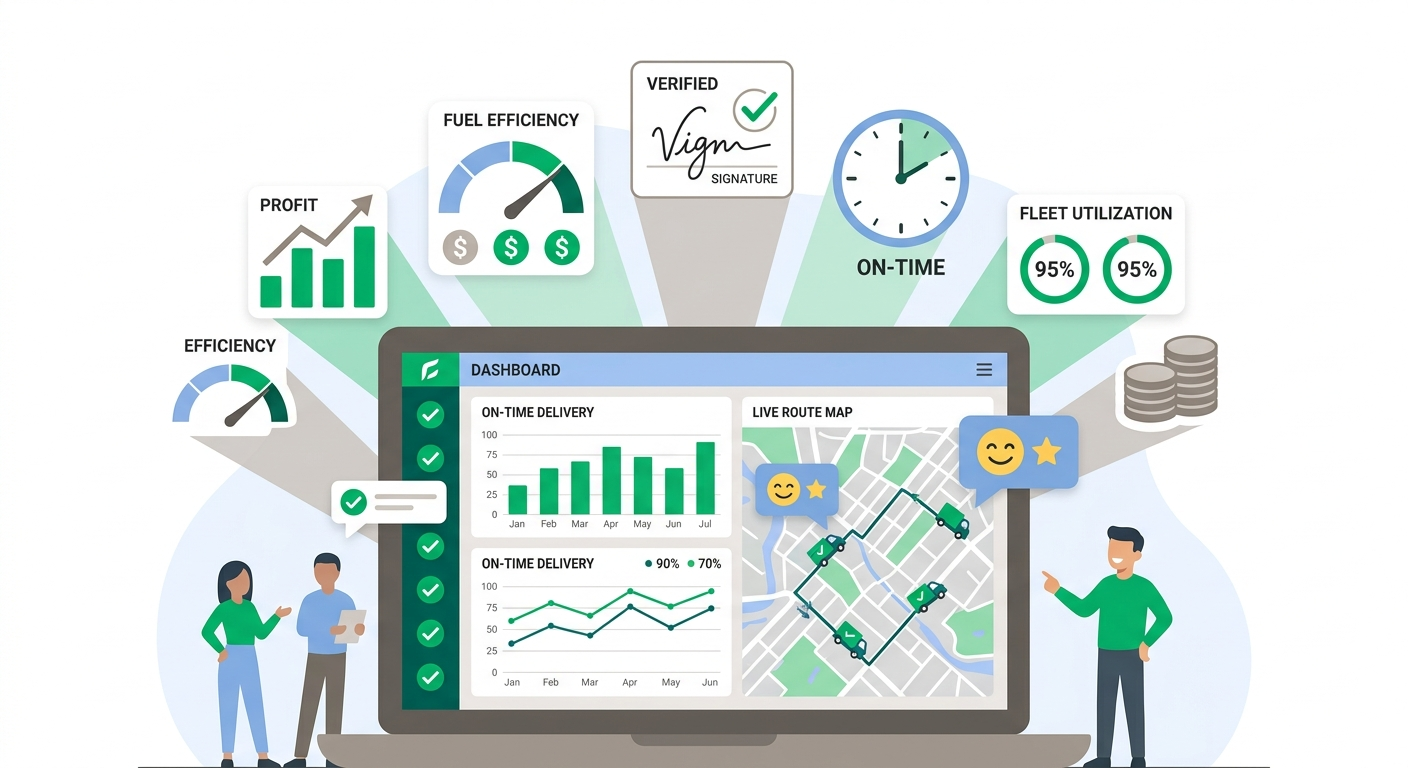
Start with operational metrics. Your analytics and reporting module ($8,000 – $18,000) should show a reduction in cost per delivery. If route optimization is working, your fuel spend per route should drop by eight to twelve percent within the first quarter. Your on-time delivery rate should climb. Your support ticket volume should fall, especially if your push notifications and in-app messaging ($5,000 – $10,000) are keeping customers informed before they feel the need to call. These are not vanity metrics. They are the numbers that determine whether your app becomes a profit center or an expensive toy.
Look at driver retention. Drivers who trust the automated payout system, who get clear route instructions, and who spend less time on administrative tasks stay longer. Recruitment is expensive. A driver app that makes the job easier is a retention tool with a measurable dollar value. If your driver turnover drops by fifteen percent, calculate the savings in hiring and training costs. That is direct ROI from your investment in the mobile experience and the fleet management software solutions layer.
Look at sales cycle acceleration. B2B shippers now expect vendor partners to offer API connectivity, live tracking portals, and automated documentation. If your courier app provides these out of the box, your sales team can shorten the vendor evaluation process. You are no longer selling a promise. You are selling infrastructure. In competitive RFPs, this is often the deciding factor. Your app becomes a client acquisition tool disguised as an operations tool.
Finally, look at your capacity to scale. A well-architected courier app built on a realistic timeline can evolve into a broader platform. The admin dashboard you built for dispatchers can become the nucleus of a full transport management system development initiative. The driver app can expand to support multi-modal delivery. The customer app can add subscription billing. Software that is built on solid foundations grows with your business. Software that is rushed becomes a constraint. That is why the thirty-eight-week timeline is not a delay. It is an investment in optionality.
Conclusion
Building a courier app is not a shortcut. It is a strategic engineering project that maps the physical movement of goods to digital workflows. A realistic timeline protects your budget, respects your drivers, and delivers a product your customers actually trust. When you approach development as an extension of your operational discipline, you get software that earns back its investment through efficiency, retention, and competitive positioning. The timeline is not an inconvenience. It is the plan that keeps your business moving.
Frequently Asked Questions
How long does it realistically take to build a custom courier app from scratch?
A fully featured courier platform with native mobile apps, real-time tracking, payment processing, and a robust admin dashboard takes thirty-six to forty weeks from discovery through stable launch. A bare-bones MVP might compress to twenty-four weeks, but anything shorter risks technical debt and operational failure.
Can we use no-code or template solutions to speed up the timeline?
Templates can produce a demo in weeks, but they rarely handle the operational complexity of courier logistics: offline driver modes, custom ERP integrations, compliance documentation, and real-time GPS at scale. For a core business asset, custom development is the only approach that avoids costly rebuilds within six months.
What is the most expensive feature to develop in a courier app?
The full admin dashboard ($15,000 – $30,000) and AI-powered load matching ($15,000 – $30,000) typically represent the largest individual line items. However, the most common budget overruns come from third-party API integrations ($10,000 – $25,000), where legacy client systems and compliance requirements demand custom middleware.
Should we build the driver app or the customer app first?
Always build the driver app and backend first. The driver is the execution layer. Without reliable scan, confirm, and document workflows, the customer has nothing to track. A solid backend-first approach ensures the customer app consumes real operational data from day one.
How do we calculate ROI after launching our courier app?
Measure operational metrics first: cost per delivery, on-time rate, fuel efficiency, and driver turnover. Then measure commercial metrics: customer acquisition cost, contract retention, and average revenue per account. A well-built app should improve operational metrics within thirty days and commercial metrics within ninety days.
Ready to Replace Spreadsheet Dispatch With a Platform That Actually Scales?
You do not need another vague estimate. You need a timeline that accounts for your drivers, your customers, and your existing systems. We build custom logistics software and fleet management software solutions that run under real-world pressure. If you are ready to turn your courier operation into a competitive advantage, book your free consultation today. We will audit your current workflow, map your integration points, and deliver a detailed project timeline with exact cost transparency for every feature. No templates. No surprises. Just a clear plan from where you are now to where your operation needs to be.
Contact us now for your free courier app development timeline consultation.