

Hiring an offshore development team sounds efficient on paper, but for logistics companies, one bad vendor choice can lead to missed milestones, unstable integrations, poor shipment visibility, and expensive rework. Operations leaders do not need “just developers.” They need a team that understands dispatch logic, carrier workflows, documentation, billing dependencies, and the difference between a good-looking product and software that actually works in live transport operations.
That is why hiring offshore for logistics software needs a more disciplined approach than a generic app project. If you are planning Custom logistics software, evaluating Supply chain management tools, or considering Transport management system development, this guide will help you understand the real process, the cost structure, and the decisions that separate a strong offshore partnership from a failed one.
1. Why Offshore Development Makes Sense for Logistics Software — and When It Does Not
Logistics businesses often go offshore for one simple reason: the work is specialized, but internal hiring is slow, expensive, and difficult to scale. A transport platform rarely needs only one engineer. It needs a coordinated team that can handle product discovery, architecture, backend logic, frontend workflows, mobile interfaces, QA, integrations, cloud deployment, and ongoing support.
That need becomes even more obvious in logistics because the software touches many moving parts:
Shippers
Brokers
Dispatchers
Carriers
Drivers
Customer service teams
Finance teams
External systems such as ERPs, telematics providers, map services, and document tools
A local in-house team can absolutely work. But many mid-sized logistics firms do not have enough predictable software demand to justify building a full internal engineering department from scratch. Offshore teams can solve that gap by giving you faster access to specialists who have already built shipping portals, carrier apps, document workflows, route planning modules, or Fleet management software solutions.
That said, offshore only works well when three conditions are true:
Your business has a clearly defined problem to solve
The offshore partner has actual logistics product experience, not just general SaaS experience
You have a strong delivery process with ownership on both sides
If any of those three pieces are missing, offshore can become a management burden instead of a growth lever.
A practical example
Imagine a regional 3PL managing orders across spreadsheets, email threads, and phone calls. Customers want self-service booking. Carriers want faster document exchange. The operations team wants fewer check calls and better status visibility. Finance wants invoicing tied to shipment milestones.
This company does not need random developers who can build forms. It needs a team that understands:
Shipment lifecycle design
User roles and permissions
Real-time tracking behavior
Digital document handling
Carrier onboarding logic
Reporting for both operations and finance
That is why the best offshore engagements in logistics are not built around “cheap coding.” They are built around domain fit, process maturity, and delivery discipline.
2. What to Define Before You Contact Any Offshore Vendor
One of the biggest mistakes buyers make is reaching out to development firms too early. If your request is “We need a logistics app,” most vendors will respond with generic enthusiasm and a vague proposal. That creates risk right away.
Before you shortlist partners, define the business case in operational terms.
Start with the workflow, not the interface
A logistics platform succeeds or fails based on workflow design. The right first question is not, “What should the dashboard look like?” It is, “How does work move from order intake to final proof of delivery and settlement?”
Document the flow in plain business language:
How does a shipment enter the system?
Who confirms capacity?
How are carriers approved?
Who updates status?
What documents must be captured?
When does finance get triggered?
What exceptions happen most often?
For example, a freight broker’s workflow may look like this:
Customer submits load request
Dispatcher reviews details
Carrier is selected and verified
Rate is confirmed
Pickup appointment is assigned
Driver or carrier updates status in transit
Proof of delivery is uploaded
Invoice is generated and sent
Operations and finance review performance data
That workflow should shape your product scope.
Define your users clearly
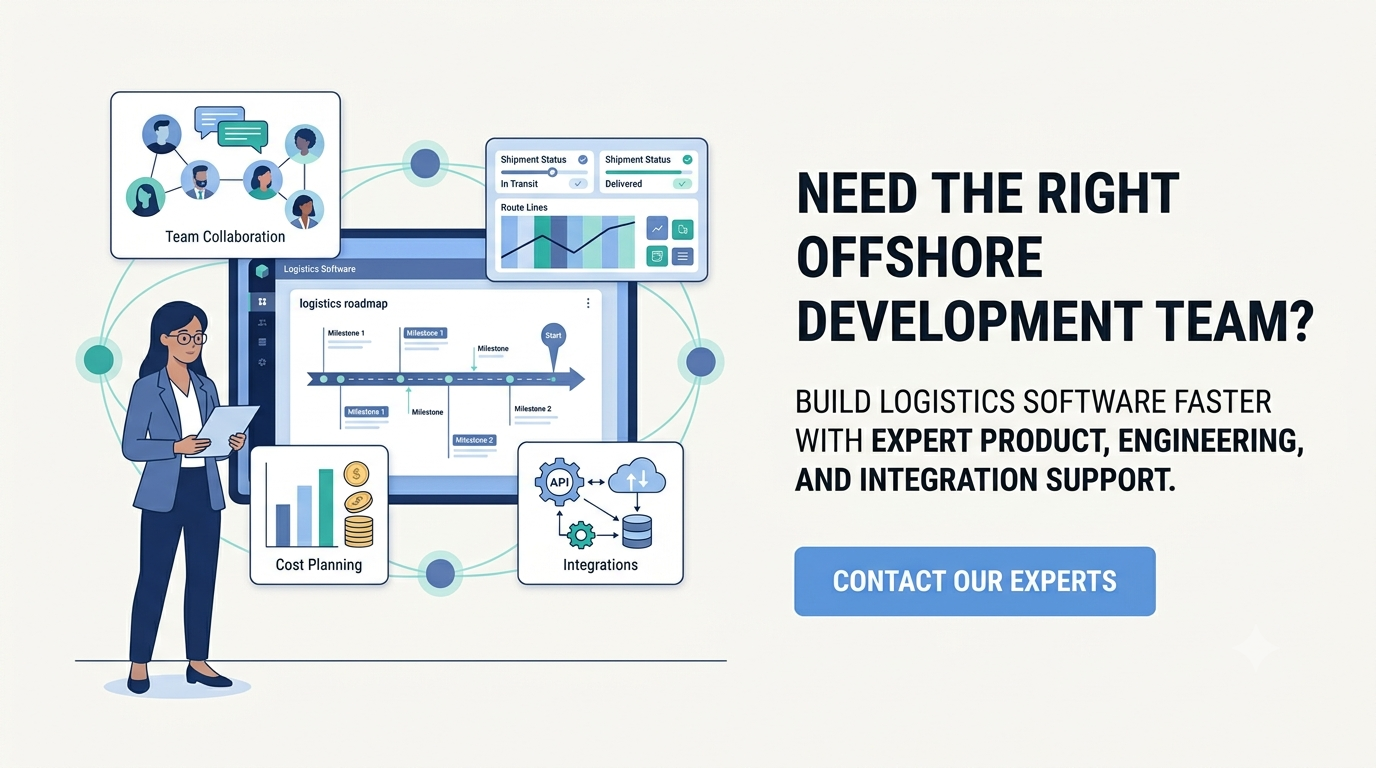
Many logistics platforms fail because they were designed only for management while ignoring daily users. Your offshore team must understand the distinct needs of each user group.
Common user profiles include:
Operations managers who need end-to-end visibility
Dispatchers who need speed and exception handling
Carriers who need booking clarity and document submission
Drivers who need simple mobile actions
Finance teams who need audit trails and billing accuracy
Customers who need ETAs, status updates, and proof of delivery
If your vendor cannot describe these user groups back to you in a structured way, they are probably not ready for serious Logistics software development.
Prioritize your MVP carefully
A first release should solve one operational problem well. It should not try to modernize the entire company in one phase.
Good MVP questions include:
What process creates the most manual work today?
What bottleneck causes customer complaints most often?
Which workflow is easy to measure after launch?
Which integration is required on day one versus later?
For example, if check calls and status uncertainty are your biggest problems, real-time tracking, milestone updates, and customer notifications may matter more than advanced analytics in phase one.
If your biggest problem is carrier chaos, then carrier verification, document collection, and load booking may take priority.
Identify your integration landscape early
Most logistics software does not operate alone. It connects to accounting systems, ERP platforms, telematics providers, map services, warehouse systems, and document tools. Offshore teams need that context from the beginning.
Your scoping brief should list:
Existing ERP or accounting system
Existing TMS or WMS, if any
Telematics or GPS data sources
EDI or API requirements
Reporting dependencies
Security or compliance expectations
Data migration needs
This is especially important if you are comparing packaged systems versus Custom logistics software. Off-the-shelf tools can cover broad use cases, but if your workflows depend on unique approval paths, carrier rules, region-specific documentation, or customer-specific status logic, custom development often becomes the better long-term route.
3. What the Right Offshore Development Team Should Look Like
A strong offshore team for logistics is not just a group of developers. It is a delivery unit with product, engineering, QA, and business analysis capability.
Core roles you should expect
For a serious logistics software project, the typical offshore structure should include:
Product manager or business analyst
Solution architect
Backend developer
Frontend web developer
Mobile developer, if drivers or field teams are involved
QA engineer
DevOps or cloud engineer
UI/UX designer for workflow-heavy interfaces
You may not need all roles full time from day one, but you should know they exist and how they will engage.
What domain knowledge looks like in practice
A logistics-aware team should be able to discuss topics like:
Multi-stop shipment flows
Dispatch board design
Carrier compliance checks
Bills of lading and proof of delivery capture
Route and ETA dependencies
Exception management
Settlement workflows
Customer status notifications
Role-based access across internal and external users
If you are building Custom TMS for trucking companies, they should also understand:
Driver assignment realities
Vehicle and trailer relationships
Route planning tradeoffs
Maintenance and availability constraints
Mobile-first workflows for field users
Communication between dispatch and drivers
Questions to ask during vendor evaluation
Ask direct, business-oriented questions:
Have you built systems for freight brokers, 3PLs, carriers, or shippers before?
What logistics workflows have you handled end to end?
How do you approach shipment status architecture?
How do you design integrations with ERP, TMS, maps, or telematics tools?
How do you test real-time tracking and document workflows?
What does your release process look like?
Who owns requirements clarification?
How do you manage time-zone overlap and escalation?
You are not looking for perfect sales language. You are looking for evidence of structured thinking.
Red flags that should worry you
Be careful if a vendor:
Talks only about technology stacks and not operations
Cannot explain how they reduce rework during discovery
Gives a fixed estimate with almost no workflow discussion
Has no QA process beyond developer testing
Avoids showing architecture thinking
Cannot describe how they handle integrations
Promises senior talent but assigns junior execution teams after signing
A good offshore partner should make your scope clearer, not murkier.
4. The Offshore Hiring Process: Step by Step
Hiring well is a process, not a procurement event. Here is a practical model that works for most B2B logistics software projects.
Step 1: Prepare a business brief
Create a short document that covers:
Business model
Target users
Workflow pain points
Desired outcomes
Required integrations
Initial feature priorities
Launch constraints
This does not need to be a massive specification. It does need enough substance for meaningful vendor conversations.
Step 2: Shortlist partners based on domain fit
Do not shortlist vendors based only on geography, price perception, or design polish. Shortlist based on relevant project experience.
Look for partners with evidence in:
Freight tech
Shipment visibility products
Driver or carrier apps
Operations dashboards
B2B workflow automation
A smaller specialist firm with real logistics depth often outperforms a larger generalist shop.
Step 3: Run a paid discovery phase
This is one of the smartest moves a buyer can make.
A discovery phase typically includes:
Stakeholder interviews
Workflow mapping
Feature prioritization
High-level architecture planning
Risk identification
Initial backlog creation
Delivery roadmap planning
Why this matters: it tests how the offshore team thinks before the main build begins.
You are not just buying documentation. You are checking whether the partner can convert operations complexity into a product plan.
Step 4: Validate the architecture approach
By this stage, the vendor should be able to explain:
How the system will be structured
How different user roles will interact
How data will move between modules
How third-party systems will connect
How scale, performance, and security will be handled
How QA and releases will work
The best offshore teams explain architecture in business terms, not just engineering jargon.
For instance, instead of saying “We will build microservices,” a good team will explain that shipment booking, tracking, documents, and reporting may need separate service boundaries over time so one heavily used module does not slow the others or make future changes risky.
Step 5: Start with a pilot or first milestone
Even if you plan a large product, begin with a limited first milestone. That gives you a safer way to test:
Communication quality
Delivery predictability
QA maturity
Documentation discipline
Response to change requests
Real sprint velocity
A first milestone might include:
User authentication
Basic shipment booking
Carrier onboarding
Admin dashboard foundation
This is enough to judge execution quality without committing the full roadmap at once.
Step 6: Set governance before scaling
Once the team proves itself, formalize delivery governance:
Weekly sprint planning
Demo cadence
Decision ownership
Change control process
UAT flow
Risk escalation path
Documentation standards
Release approval process
Many offshore relationships fail not because the engineers are weak, but because ownership is unclear.
Step 7: Scale based on roadmap, not emotion
Do not add headcount simply because progress feels slower than expected. First check whether the problem is actually unclear requirements, too many stakeholder changes, or weak prioritization.
Add team capacity when:
There is validated product direction
The backlog is ready
QA can keep up
Integrations are planned properly
Internal business owners can make timely decisions
More developers do not automatically mean faster logistics software delivery. In workflow-heavy systems, clarity beats headcount.
5. Cost Planning: What Offshore Logistics Software Really Costs
This is where many buyers make poor decisions. They ask for a single number before the workflow is defined, then compare proposals as if all vendors are estimating the same thing.
They are not.
The cost of offshore development depends on the number of modules, the complexity of business rules, the number of integrations, mobile versus web scope, real-time requirements, and reporting needs. For logistics platforms, the feature set has a major impact on budget.
Below are the exact feature-level cost references you can use when discussing scope with offshore partners.
Common logistics software feature costs
User onboarding & authentication: $5,000 – $10,000
Shipment creation & booking workflow: $8,000 – $15,000
Real-time GPS tracking & mapping: $10,000 – $20,000
AI-powered load matching algorithm: $15,000 – $30,000
Dynamic pricing engine: $12,000 – $25,000
In-app payments & payouts: $8,000 – $18,000
Digital documentation (BOL, POD, invoices): $7,000 – $14,000
Push notifications & in-app messaging: $5,000 – $10,000
Admin dashboard (full): $15,000 – $30,000
Analytics & reporting module: $8,000 – $18,000
Carrier onboarding & verification: $6,000 – $12,000
Route optimization engine: $12,000 – $22,000
Third-party API integrations (ERP, TMS, maps): $10,000 – $25,000
How to use these numbers properly
Do not treat them as a shopping list detached from operations. Treat them as building blocks that should map directly to your workflow.
For example:
Scenario A: Freight brokerage platform
A broker building a carrier-facing and customer-facing solution may prioritize:
User onboarding & authentication
Shipment creation & booking workflow
Carrier onboarding & verification
Real-time GPS tracking & mapping
Digital documentation
Admin dashboard
Analytics & reporting
Third-party API integrations
Why these modules matter:
Booking drives load creation
Carrier onboarding reduces compliance friction
Tracking improves visibility
Digital documentation speeds invoicing
Reporting supports operations control
Integrations connect the software to the existing business
Scenario B: Mid-sized trucking operation
A carrier focused on Custom TMS for trucking companies may care most about:
User onboarding & authentication
Real-time GPS tracking & mapping
Route optimization engine
Digital documentation
Push notifications & in-app messaging
Admin dashboard
Analytics & reporting
Third-party API integrations
Why these modules matter:
Dispatch efficiency depends on accurate routing and driver communication
Documents support proof of delivery and back-office speed
Reporting helps identify idle assets, route performance, and service issues
Scenario C: Digital freight marketplace
A broker or marketplace startup may prioritize:
User onboarding & authentication
Shipment creation & booking workflow
AI-powered load matching algorithm
Dynamic pricing engine
In-app payments & payouts
Carrier onboarding & verification
Push notifications & in-app messaging
Admin dashboard
Third-party API integrations
Why these modules matter:
Matching and pricing shape monetization
Payments improve platform stickiness
Messaging keeps transactions moving without email chaos
The hidden cost driver buyers often miss: rework
In offshore projects, rework is often more expensive than the original build effort. Rework happens when:
Requirements were too vague
Business rules were not documented
User roles were oversimplified
Edge cases were ignored
Integration behavior was discovered too late
QA began after development instead of during it
That is why the cheapest-looking proposal often becomes the most expensive project.
A simple budgeting principle
Budget by workflow stack, not by app label.
Saying “We need a logistics platform” is too broad. Saying “We need shipment booking, carrier verification, GPS tracking, digital documents, and ERP integration in phase one” produces a far better planning conversation.
6. The Architecture Choices That Determine Long-Term ROI
This is where many software projects either become scalable business assets or expensive internal headaches.
Good software architecture is not an academic exercise. In logistics, architecture directly affects operational speed, reliability, integration flexibility, and the cost of future changes.
Start with a modular operational core
For most logistics products, a modular architecture works well because the business naturally breaks into domains such as:
Orders and shipments
Carriers and drivers
Tracking and status events
Documents
Billing and settlement
Reporting and analytics
Customer notifications
Admin and permissions
This does not mean you need a highly fragmented system from day one. It means the offshore team should design clear boundaries so the product can grow without becoming brittle.
Why this matters for ROI:
New features can be added with less disruption
Bugs in one area are less likely to affect the whole platform
Integrations are easier to maintain
Performance tuning becomes more targeted
Use an API-first mindset
In logistics, software almost always needs to exchange data with other systems. That is why API-first thinking matters.
An API-first approach helps when you need to:
Connect with ERP or accounting tools
Pull GPS data from telematics providers
Expose shipment status to customer portals
Sync documents and invoice states
Feed operational data into analytics systems
If your offshore team designs the product only as a collection of screens, future integrations become painful. If they design the core around reusable services and clean data flows, you gain flexibility.
Design for event-driven status updates
Real-time logistics systems rely on status changes: booked, assigned, picked up, in transit, delayed, delivered, exception raised, proof uploaded, invoice ready.
A good architecture captures those events consistently and makes them available across the product. That affects:
Customer visibility
Internal dashboards
Alerts and notifications
Reporting accuracy
Billing triggers
SLA measurement
In practical terms, this means your offshore team should think carefully about how status changes are created, validated, stored, and shared.
Do not treat documents as an afterthought
In logistics, documents are part of the operational transaction, not just attachments.
Bills of lading, proof of delivery, invoices, rate confirmations, compliance records, and carrier documents often determine whether a shipment can be billed, closed, or disputed.
Your architecture should account for:
Document upload and retrieval
User-specific permissions
Version control where needed
Audit trail visibility
Search and filtering
Ties to shipment or carrier records
This has a direct ROI impact because document delays often delay cash flow.
Mobile workflow quality matters more than flashy design
If drivers, carriers, or field staff use the system, mobile usability matters a lot. A bad mobile experience creates missing updates, poor data quality, and low adoption.
For Fleet management software solutions and dispatch-heavy platforms, the offshore team should understand:
Limited attention spans in field operations
Intermittent network conditions
Fast status updates with minimal taps
Clear upload flows for photos and documents
Role-specific interfaces instead of cluttered screens
In transport software, adoption is a business issue, not just a design issue.
Integrations often create the biggest ROI
A logistics product can look polished and still fail if it does not fit the company’s system environment.
Strong integrations matter because they reduce duplicate data entry and improve process continuity. This is where Supply chain management tools often rise or fall in real usage. Users do not want to enter the same order in three systems.
A smart offshore team plans for:
ERP sync
TMS interoperability
Map and geolocation services
Accounting workflows
Notification channels
Data export and reporting pipelines
That is why Third-party API integrations (ERP, TMS, maps): $10,000 – $25,000 is often one of the most valuable line items in the entire project.
Hypothetical case study: 3PL visibility improvement
A mid-market 3PL had rising customer complaints because shipment updates depended on manual calls and email threads. The offshore team built phase one around:
Shipment creation & booking workflow
Real-time GPS tracking & mapping
Push notifications & in-app messaging
Digital documentation
Admin dashboard
Analytics & reporting
The business result was not “better software” in a vague sense. The result was:
Fewer check calls
Faster proof-of-delivery collection
Better customer confidence
Less dispatcher time spent on repetitive status work
Stronger visibility into delay patterns
That is real ROI: lower manual effort, better service quality, and more usable operational data.
7. Expert Tips to Make Offshore Delivery Work After the Contract Is Signed
The contract is not the hard part. Ongoing execution is.
Tip 1: Assign a real internal product owner
Do not leave the offshore team waiting for answers from five different managers. Appoint one decision-maker who can clarify priorities, approve workflows, and resolve tradeoffs quickly.
Without that role, even good teams lose momentum.
Tip 2: Define “done” in business terms
A feature is not done because developers finished the code. It is done when:
Business rules are implemented
QA is complete
Edge cases are tested
User acceptance criteria are met
Documentation is updated
Release readiness is confirmed
This is especially important in Logistics software development, where exceptions are common and operational errors are expensive.
Tip 3: Demand demoable progress every sprint
Avoid long silent build periods. You should see working progress often.
Sprint demos should show:
What changed
What business scenario it solves
What remains unresolved
What feedback is needed before the next sprint
This reduces misunderstanding early, when correction is cheaper.
Tip 4: Test with real operations users
Do not rely only on leadership feedback. Dispatchers, customer service staff, carrier managers, and finance users will spot practical issues that senior stakeholders miss.
For example:
A dispatcher may point out that status update steps take too many clicks
A finance user may notice document naming inconsistencies
A carrier manager may flag a verification workflow that creates delays
A customer service rep may need a better exception history view
Tip 5: Measure operational outcomes, not just feature completion
Track metrics such as:
Time to create or assign shipments
Status update latency
Proof-of-delivery turnaround time
Manual calls or email volume
Carrier onboarding cycle time
Invoice processing speed
User adoption by role
These are the numbers that prove whether the offshore build is helping the business.
Tip 6: Plan phase two before phase one goes live
The best offshore teams think beyond launch. Once users adopt the core platform, the next wave of priorities usually becomes visible fast.
A trucking company may start with dispatch and tracking, then realize it needs:
Better route optimization
Maintenance-linked vehicle availability
Deeper analytics
Customer self-service tracking pages
Broader integration with enterprise systems
A freight marketplace may launch booking and matching, then need:
Better pricing controls
Payout workflows
Fraud prevention layers
Regional compliance extensions
Launch is the midpoint, not the finish line.
Tip 7: Protect architecture quality as scope grows
When the business sees early success, stakeholders often request many additions at once. That is normal. But growth should be managed carefully.
Every new feature should be evaluated for:
Workflow fit
Data dependencies
Reporting impact
User experience impact
Technical debt implications
This matters a lot in long-term Custom logistics software programs, where a platform may expand across regions, business units, or customer segments.
Conclusion
Hiring an offshore development team for logistics software can be an excellent business decision when it is handled with discipline. The companies that get the best results do not shop for the lowest bid. They define the workflow, choose domain-aware partners, validate architecture early, budget by feature stack, and manage delivery with real operational ownership.
Whether you are planning Transport management system development, comparing Supply chain management tools, or building Custom TMS for trucking companies, the right offshore team should do more than write code. They should help you create a reliable software foundation that reduces manual work, improves shipment visibility, supports growth, and produces measurable ROI.
FAQs
1. How do I know if an offshore team is qualified for logistics software projects?
Look for proof of logistics-specific delivery, not just generic SaaS work. Ask about shipment workflows, carrier onboarding, proof-of-delivery handling, routing logic, integrations, and reporting. A qualified partner should be able to discuss operational use cases in detail.
2. Is offshore development a good choice for Custom logistics software projects?
Yes, if your internal team lacks the full product, engineering, QA, and integration capacity. Offshore can work very well for logistics projects when the partner has domain expertise and you provide clear business ownership.
3. What is the best engagement model for Logistics software development?
For complex B2B platforms, a discovery phase followed by a dedicated team model is often the best fit. It gives you structured planning first, then ongoing flexibility as requirements evolve.
4. Can offshore teams build Fleet management software solutions and driver-facing apps effectively?
Yes, but only if they understand mobile workflow simplicity, real-time status updates, map behavior, intermittent connectivity, and dispatch operations. Field-user adoption is one of the main quality tests in these projects.
5. Should I buy off-the-shelf software or invest in Custom TMS for trucking companies ?
If your operations are relatively standard, an off-the-shelf platform may be enough. If you have unique dispatch rules, customer-specific workflows, specialized integrations, or growth plans that packaged tools cannot support well, custom development is often the better long-term option.