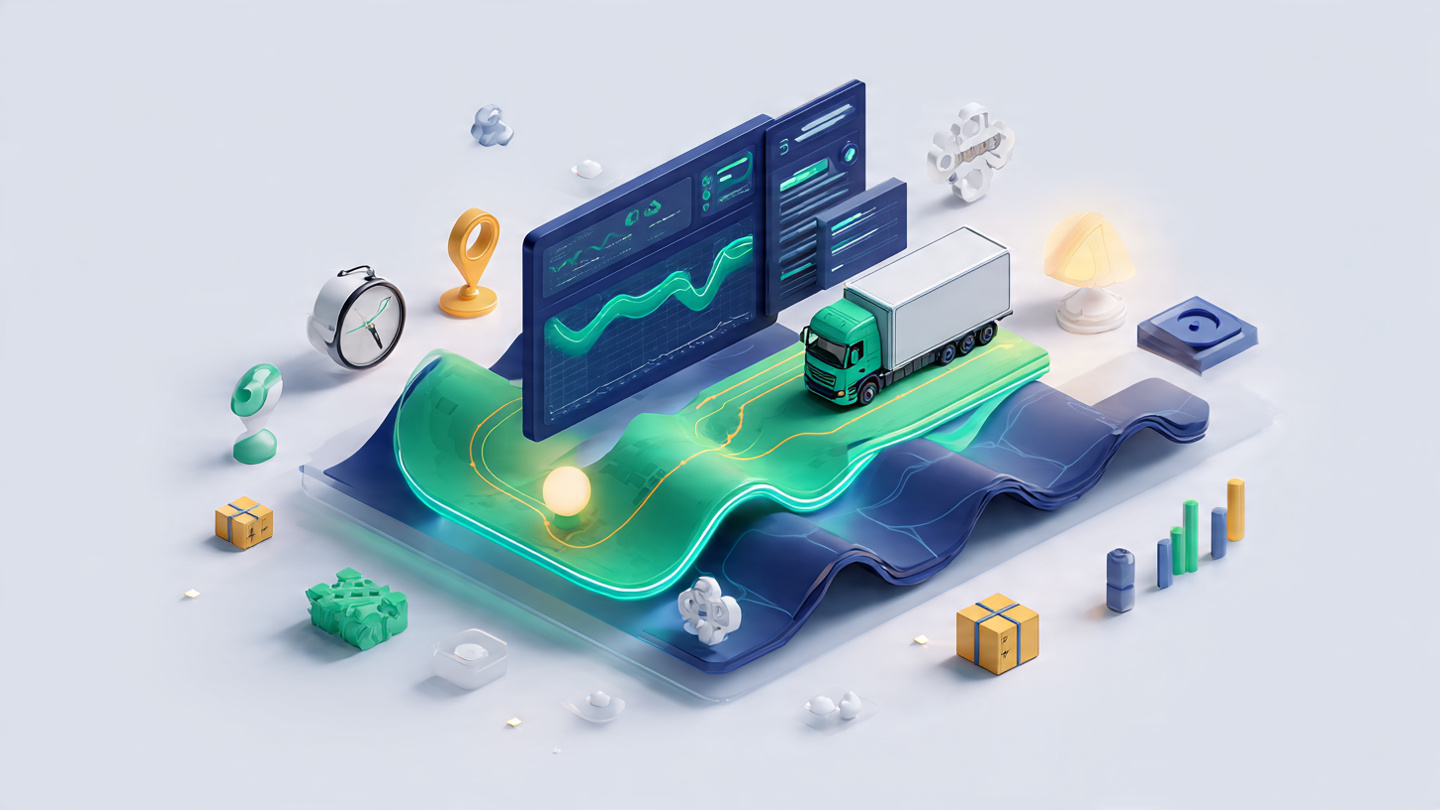

You are a healthcare operator or a logistics-driven health business in the UK, and you have been watching telemedicine adoption explode since the pandemic shifted patient expectations permanently. You know the market is there. You know the NHS is pushing digital-first care. But every time you sit down to budget the build, you hit the same wall: nobody will give you a straight answer on what it actually costs. Vendors quote £50K, agencies quote £500K, and nobody explains what sits behind those numbers. This post does.
We are going to break down the real cost to build a telemedicine app in the UK — feature by feature, layer by layer — and show you exactly where the money goes, why it goes there, and how the architecture choices you make early on determine whether your platform scales or stalls. Along the way, we will draw direct parallels to logistics and supply chain software, because a modern telemedicine platform is, at its core, a coordination engine — scheduling, routing, tracking, and fulfilling requests across a distributed network of providers and patients. The same engineering principles that power Custom logistics software power telemedicine.
1. The UK Telemedicine Market: Why the Timing Matters More Than Ever
The UK telemedicine market is not a speculative bet anymore. It is a live, growing, regulated ecosystem with real revenue attached to it.
The NHS Long Term Plan explicitly targets digitally-enabled care pathways. Private operators like Babylon Health (before its restructuring), Livi, Push Doctor, and Kry have proven that UK patients will adopt virtual consultations at scale. GP appointment data from NHS Digital shows that over 30% of consultations now happen remotely in some form.
But here is what most cost guides miss: building a telemedicine app in the UK is not just about connecting a patient to a doctor over video. A production-grade platform must handle:
NHS integration — connecting to GP systems, the NHS App, and Spine for patient record lookup
CQC compliance — the Care Quality Commission regulates telemedicine providers, and your software architecture must support audit trails, consent management, and clinical governance
Prescription fulfilment logistics — if your platform issues prescriptions, you need a pipeline that routes e-prescriptions to pharmacies, tracks delivery, and confirms dispensing
Home visit coordination — for platforms offering hybrid care, you need scheduling, route planning, and real-time tracking for clinicians visiting patients at home
That last point is where telemedicine and logistics converge. Routing a community nurse to 12 home visits across London is fundamentally a route optimization problem — the same class of problem that Transport management system development solves for freight carriers. The underlying algorithms — constraint-based scheduling, real-time traffic re-routing, arrival-time prediction — are shared across both domains.
This convergence matters for your budget, because if you design your telemedicine platform with logistics-aware architecture from day one, you avoid the massive re-engineering cost that hits operators when they later add prescription delivery or home visit features as bolt-ons.
2. Core Feature Costs: What You Pay For and Why
Let us get into the numbers. Below is a feature-by-feature breakdown using verified development cost ranges. These figures reflect mid-market UK/European development rates (typically £80–£150/hour) applied to realistic scope for each module.
User Onboarding & Authentication: $5,000 – $10,000
Every telemedicine app starts here. But in healthcare, onboarding is not a simple email-and-password form. You need:
NHS Login integration — the UK's single sign-on standard for health services. Implementing NHS Login requires OAuth2 flows, identity verification (matching against NHS number), and compliance with NHS Digital's integration criteria
Role-based access control (RBAC) — patients, clinicians, pharmacists, administrators, and support staff each need distinct permission sets
GDPR-compliant consent capture — explicit opt-in mechanisms for data processing, with audit logs
A lean implementation sits at the lower end ($5,000). If you need multi-factor authentication, biometric login (Face ID / fingerprint), and automated identity verification against NHS records, you move toward $10,000.
This module mirrors what Supply chain management tools require for user access — the same RBAC logic applies whether you are granting a clinician access to patient records or a warehouse manager access to shipment data.
Real-Time GPS Tracking & Mapping: $10,000 – $20,000
Wait — GPS tracking in a telemedicine app? Yes, and here is why.
If your platform supports home visits (physiotherapists, community nurses, mobile phlebotomists), you need real-time location tracking for:
Clinician en-route visibility — patients see an estimated arrival time, just like a delivery tracking page
Safety monitoring — lone-worker safety features that track clinician location during home visits and trigger alerts if they do not check in
Dispatch optimization — assigning the nearest available clinician to an urgent request
This is architecturally identical to the GPS tracking layer in Fleet management software solutions. You are consuming map tiles (Mapbox, Google Maps, or OpenStreetMap), processing geolocation pings from mobile devices, computing ETAs, and rendering live position updates on a dashboard.
Cost variance here depends on whether you use off-the-shelf mapping SDKs with minimal customization (lower end) or build custom geofencing, heatmap overlays for demand forecasting, and multi-stop route visualization (upper end).
AI-Powered Load Matching Algorithm: $15,000 – $30,000
"Load matching" is a freight term, but the concept translates directly to telemedicine as patient-to-clinician matching.
When a patient requests a consultation, your platform needs to match them with the right clinician based on:
Specialty — dermatology, mental health, paediatrics, general practice
Availability — real-time schedule slots
Language — patients may request consultations in Welsh, Urdu, Polish, or other languages common in the UK
Acuity — urgency level and clinical complexity
Geography — for home visits, the clinician must be within a viable travel radius
Building this as a deterministic rules engine (if specialty = X, route to pool Y) sits at the lower end. Building it as a true AI matching system — one that learns from consultation outcomes, patient satisfaction scores, and clinician capacity patterns — pushes you toward $30,000.
In logistics, this same algorithmic class drives the AI-powered load matching algorithm that pairs freight with available carriers. The math is the same: multi-variable optimization over a constrained resource pool. Your telemedicine platform is matching patients to doctors the way a Custom TMS for trucking companies matches loads to trucks.
Dynamic Pricing Engine: $12,000 – $25,000
If your telemedicine platform operates in the private market (not exclusively NHS-funded), pricing is not static. You need a dynamic pricing engine that adjusts consultation fees based on:
Time of day — evening and weekend premiums
Demand surges — flu season, pandemic waves
Specialty scarcity — psychiatrists command higher fees than GPs
Patient membership tier — subscription plans vs. pay-per-consult
A simple tiered pricing table with time-of-day modifiers lands around $12,000. A fully dynamic system that integrates real-time demand signals, competitor pricing data, and margin targets pushes toward $25,000.
In-App Payments & Payouts: $8,000 – $18,000
Payment processing in UK healthcare has specific requirements:
Stripe or GoCardless integration — for patient-facing payments
BACS transfers — for clinician payouts (many UK clinicians expect direct bank transfers, not platform wallets)
NHS tariff reconciliation — if your platform bills the NHS, you need to generate invoices that align with NHS tariff codes
Insurance claim routing — for platforms accepting private health insurance (Bupa, AXA PPP, Vitality)
Basic Stripe integration with single-currency billing sits at $8,000. Multi-currency, split payments (platform fee + clinician fee), insurance claim routing, and automated VAT handling push you toward $18,000.
Digital Documentation (BOL, POD, Invoices): $7,000 – $14,000
In telemedicine, "documentation" means:
E-prescriptions — generated during consultation, transmitted to the patient's chosen pharmacy via the NHS Electronic Prescription Service (EPS)
Consultation summaries — structured clinical notes that are stored in the patient record and sent to the patient
Medical certificates — fit notes, sick notes, and referral letters generated digitally
Invoices and receipts — for private consultations
In the logistics world, this module handles Bills of Lading, Proof of Delivery documents, and freight invoices. The technical pattern is the same: template-based document generation, digital signatures, secure storage, and audit-compliant retrieval. Logistics software development teams build these workflows identically for freight documents and medical documents — the compliance framework changes, but the architecture does not.
Push Notifications & In-App Messaging: $5,000 – $10,000
Telemedicine platforms rely heavily on notifications for:
Appointment reminders — reducing no-shows (which cost UK private clinics an estimated £200+ per missed slot)
Prescription ready alerts — notifying patients when their medication is available for collection or delivery
Clinician arrival alerts — for home visit services
Secure in-app messaging — for asynchronous follow-up between consultations
Basic push notification integration (FCM for Android, APNs for iOS) with templated messages sits at $5,000. End-to-end encrypted in-app messaging with file sharing, read receipts, and message archival for compliance pushes toward $10,000.
Admin Dashboard (Full): $15,000 – $30,000
Your operations team needs a comprehensive dashboard to manage:
Clinician rostering — schedules, availability, and on-call rotations
Patient queue management — real-time visibility into waiting patients
Financial reporting — revenue, clinician payouts, NHS billing reconciliation
Compliance monitoring — CQC audit trails, consent records, data access logs
Service configuration — adding new specialties, adjusting pricing, managing regions
A full admin dashboard is one of the most expensive modules because it touches every data entity in your system. The lower end covers a functional dashboard with basic CRUD operations. The upper end covers a rich, real-time dashboard with role-specific views, custom report builders, and operational alerts.
Analytics & Reporting Module: $8,000 – $18,000
For a telemedicine platform, analytics must cover:
Clinical KPIs — average consultation duration, prescription rates, patient outcomes
Operational KPIs — no-show rates, wait times, clinician utilization
Financial KPIs — revenue per consultation, cost per acquisition, margin by specialty
Compliance metrics — data access events, consent opt-out rates, incident reports
A pre-built analytics integration (e.g., connecting to Metabase or Looker) sits at the lower end. A custom analytics engine with real-time dashboards, predictive modelling, and automated anomaly detection pushes toward $18,000.
Carrier Onboarding & Verification: $6,000 – $12,000
In telemedicine, "carrier onboarding" translates to clinician onboarding and verification. Before a clinician can consult on your platform, you must:
Verify GMC registration — checking against the General Medical Council's register
Validate DBS clearance — Disclosure and Barring Service checks for safeguarding
Confirm indemnity insurance — ensuring the clinician holds adequate professional cover
Collect credentials — qualifications, specialties, languages, availability preferences
Activate profile — making the clinician discoverable in the matching system
This is structurally identical to the carrier onboarding workflows built in Logistics software development — the same document upload, verification pipeline, approval workflow, and activation logic. The compliance criteria are different (GMC vs. operator licence), but the software pattern is the same.
Route Optimization Engine: $12,000 – $22,000
For telemedicine platforms offering home visits, route optimization is a core capability. A community nurse visiting 8–10 patients per day across a city like Manchester needs:
Multi-stop route planning — optimal sequence of visits to minimise travel time
Time window constraints — some patients require visits within specific slots (e.g., insulin administration at fixed times)
Skill-based assignment — matching visit requirements to clinician competencies
Real-time re-optimization — adjusting routes when an urgent visit is added mid-shift
This is the same route optimization problem that Custom TMS for trucking companies solves. The algorithmic foundations — vehicle routing problem (VRP) solvers, constraint satisfaction, real-time traffic data integration — are shared across both domains.
A basic implementation using off-the-shelf routing APIs (Google Directions, GraphHopper) with manual sequence selection sits at $12,000. A custom solver with real-time re-optimization, skill-based constraints, and predictive travel time models pushes toward $22,000.
Third-Party API Integrations (ERP, TMS, Maps): $10,000 – $25,000
A UK telemedicine platform typically integrates with:
NHS Spine — for patient demographic lookup and PDS (Personal Demographics Service) queries
NHS Electronic Prescription Service (EPS) — for transmitting prescriptions to pharmacies
EHR systems — EMIS Web, SystmOne (the two dominant UK GP systems)
Mapping providers — Google Maps, Mapbox, or Ordnance Survey for location services
Payment gateways — Stripe, GoCardless
Communication APIs — Twilio or Vonage for video calling infrastructure
Each integration carries its own development, testing, and certification cost. NHS integrations in particular require going through NHS Digital's assurance process, which adds time and cost.
The lower end covers 2–3 straightforward REST API integrations. The upper end covers 5+ integrations including NHS-specific certified connections.
3. Total Cost Ranges: What You Should Actually Budget
Let us aggregate the feature costs into realistic build scenarios.
Scenario A: MVP Telemedicine Platform (Video Consultations Only)
Feature | Cost Range |
|---|---|
User onboarding & authentication | $5,000 – $10,000 |
In-app payments & payouts | $8,000 – $18,000 |
Push notifications & in-app messaging | $5,000 – $10,000 |
Digital documentation | $7,000 – $14,000 |
Admin dashboard (basic) | $15,000 – $30,000 |
Subtotal | $40,000 – $82,000 |
This gets you a functional video consultation platform with booking, payment, and basic documentation. You are not doing home visits, prescription delivery, or AI matching yet.
Scenario B: Full Telemedicine Platform with Home Visits & Prescription Delivery
Feature | Cost Range |
|---|---|
User onboarding & authentication | $5,000 – $10,000 |
Real-time GPS tracking & mapping | $10,000 – $20,000 |
AI-powered load matching (patient-to-clinician) | $15,000 – $30,000 |
Dynamic pricing engine | $12,000 – $25,000 |
In-app payments & payouts | $8,000 – $18,000 |
Digital documentation | $7,000 – $14,000 |
Push notifications & in-app messaging | $5,000 – $10,000 |
Admin dashboard (full) | $15,000 – $30,000 |
Analytics & reporting module | $8,000 – $18,000 |
Carrier/clinician onboarding & verification | $6,000 – $12,000 |
Route optimization engine | $12,000 – $22,000 |
Third-party API integrations | $10,000 – $25,000 |
Subtotal | $123,000 – $234,000 |
This is a production-grade platform that can compete with the major UK telemedicine operators. It supports video consultations, home visits, prescription fulfilment, AI-driven matching, and full NHS integration.
Scenario C: Enterprise Telemedicine + Logistics Platform
If you are building a platform that also manages the pharmaceutical supply chain — routing medication from wholesale distributors to pharmacies to patients — you add:
Warehouse management integration
Cold-chain monitoring for temperature-sensitive medications
Last-mile delivery tracking for prescription deliveries
This pushes the total into the $180,000 – $350,000+ range, depending on the depth of supply chain integration.
4. Architecture Decisions That Determine Cost (and Scalability)
The feature list tells you what you are building. The architecture tells you whether it will hold up at scale. Here are the decisions that matter most for UK telemedicine platforms.
Monolith vs. Microservices
For an MVP, a monolithic architecture is perfectly fine. It is faster to build, easier to debug, and cheaper to deploy. You can build the entire application as a single codebase (e.g., a Node.js or Django application) and deploy it on a single server cluster.
But if you plan to scale to 50,000+ consultations per month, microservices become necessary. You want the video calling service to scale independently from the payment service. You want the matching engine to scale independently from the notification service. Each microservice can be deployed, updated, and scaled without affecting the others.
The cost difference? A monolithic MVP might take 3–4 months to build. A microservices architecture might take 6–8 months — roughly doubling the development cost but halving the long-term maintenance burden.
This is the same trade-off that Custom logistics software projects face. A small freight broker can run on a monolith. A national carrier network needs microservices.
Real-Time Communication Stack
Video calling is the heart of telemedicine, and the technology choice here has major cost implications:
WebRTC (custom) — maximum control, maximum cost. You build your own signalling server, TURN/STUN infrastructure, and media routing. Budget $30,000–$60,000 for the video calling layer alone
Twilio Video / Vonage Video API — managed WebRTC. You pay per minute (Twilio charges ~$0.004/min for group rooms), but development cost drops to $10,000–$20,000
Ready-made SDKs (Agora, 100ms) — fastest integration, lowest upfront cost ($8,000–$15,000), but per-minute pricing can become expensive at scale
For most UK operators starting out, Twilio Video or Vonage provides the right balance. You get production-grade video quality without the infrastructure overhead, and you can always migrate to custom WebRTC later if per-minute costs become prohibitive.
Data Residency and Hosting
UK healthcare data must comply with the UK GDPR and the Data Protection Act 2018. In practice, this means your patient data must be stored on servers within the UK or in countries with adequate data protection status.
AWS (London region), Microsoft Azure (UK South), and Google Cloud (London) all offer UK-based hosting. The cost difference between UK hosting and US hosting is minimal for compute and storage, but network egress costs can be higher. Budget an additional 10–15% on infrastructure costs for UK data residency compliance.
5. Hypothetical B2B Case Study: MediRoute UK
Company: MediRoute UK (hypothetical) — a London-based telemedicine operator offering GP video consultations and community nurse home visits across Greater London.
The Challenge: MediRoute launched in 2023 with a basic video consultation platform. By mid-2024, they had 15,000 registered patients but were losing revenue because:
No-show rates for home visits were at 22% (patients not receiving arrival-time updates)
Nurse scheduling was manual — a coordinator spent 3 hours/day building routes on Google Maps
Prescription delivery was outsourced with no tracking, leading to patient complaints
The Build: MediRoute commissioned a platform rebuild with logistics-aware architecture:
Real-time GPS tracking ($15,000) — nurses share live location; patients receive SMS with a tracking link and estimated arrival time
Route optimization engine ($18,000) — automatically sequences nurse visits based on patient time windows, travel time, and clinical priority
AI-powered patient-to-clinician matching ($22,000) — routes home visit requests to the nearest available nurse with the right clinical skills
Digital documentation ($10,000) — e-prescriptions generated during consultations are transmitted directly to the patient's nominated pharmacy via NHS EPS
Push notifications ($7,000) — appointment reminders, nurse en-route alerts, and prescription-ready notifications
Total build cost: ~$72,000 for the five new modules, plus migration from the legacy platform.
The Results (after 6 months):
No-show rate dropped from 22% to 9% (arrival-time notifications were the single biggest factor)
Nurse scheduling time dropped from 3 hours/day to 20 minutes/day (automated route optimization)
Each nurse completed 2–3 additional visits per day (better routing)
Prescription delivery complaints fell by 67% (EPS integration + delivery tracking)
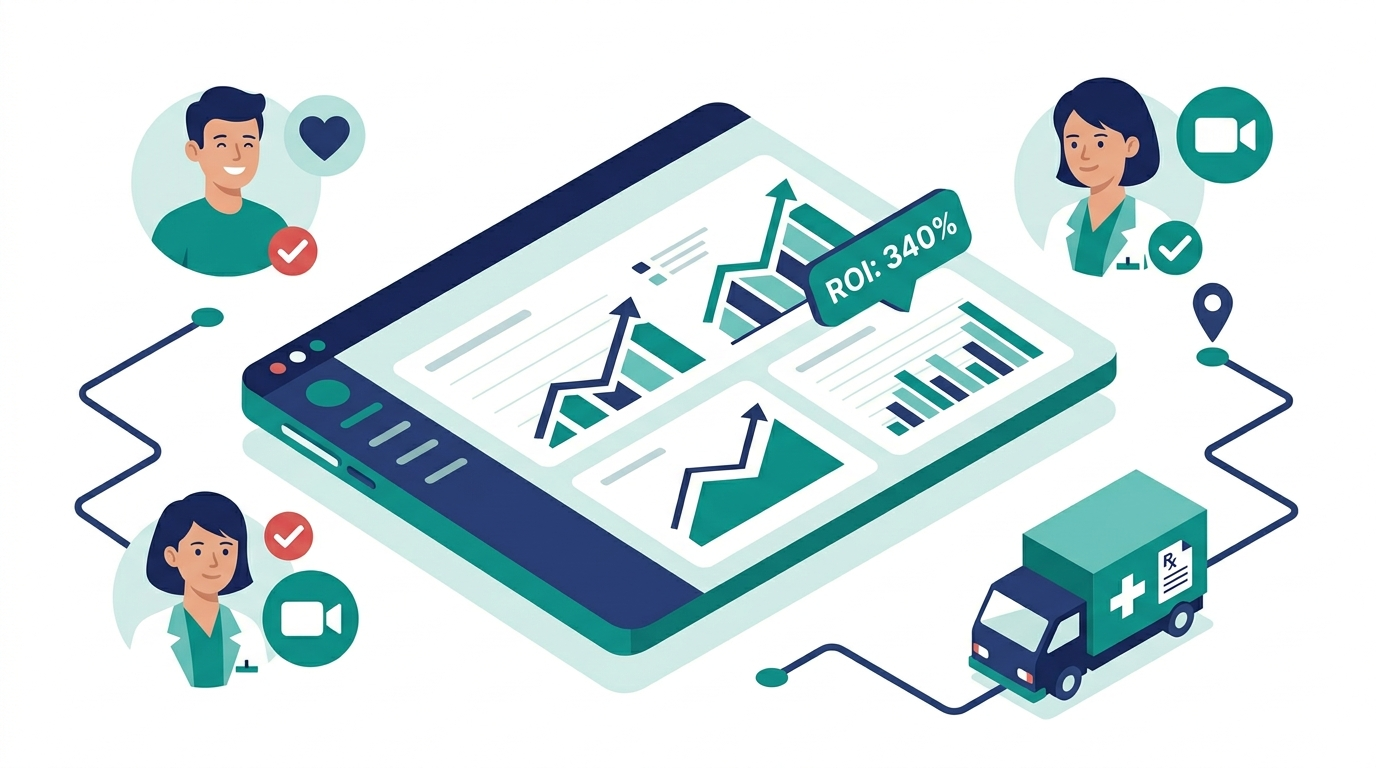
Projected annual ROI: £340,000 in recovered revenue and operational savings against a one-time build cost of ~£57,000
This case study illustrates a principle that applies equally to healthcare and logistics: the money is in the coordination layer. Video calling is a commodity. The competitive advantage comes from how efficiently you match supply (clinicians) to demand (patients) and how reliably you fulfil the service (arriving on time, delivering prescriptions). That is why Transport management system development expertise translates so directly to telemedicine — the coordination problems are the same.
6. Hidden Costs That Most Budgets Miss
Beyond the feature development costs, there are several line items that consistently surprise first-time telemedicine operators.
NHS Integration Certification
Connecting to NHS systems is not just a technical task — it is a governance process. You need to:
Register as a supplier on the NHS Digital Supplier Hub
Complete the NHS Digital Data Security and Protection Toolkit (DSPT)
Pass integration testing with NHS Digital's assurance team
Obtain an NHS smartcard for each system user in certain workflows
This process typically takes 3–6 months and costs £10,000–£25,000 in staff time and consulting fees, depending on your existing compliance posture.
CQC Registration
If your telemedicine platform provides regulated clinical services in England, you must register with the Care Quality Commission. This involves:
Submitting a detailed application describing your governance structure, clinical protocols, and quality assurance processes
Demonstrating that your software supports clinical audit, incident reporting, and consent management
Paying registration fees (typically £2,000–£5,000 depending on the number of locations and service types)
Ongoing Compliance and Security Audits
Healthcare platforms require regular penetration testing (at least annually), GDPR Data Protection Impact Assessments (DPIAs) for new features, and ongoing monitoring for clinical safety incidents. Budget £15,000–£30,000 per year for compliance activities.
Clinical Safety (DCB 0129 and DCB 0160)
UK health IT systems must comply with DCB 0129 (manufacturer's risk management) and DCB 0160 (deployer's risk management). These standards require a formal Hazard Log, clinical risk assessments, and a Clinical Safety Officer (CSO) who signs off on the system's safety case. If you do not have a CSO on staff, you will need to engage one as a consultant — typically £5,000–£10,000 for the initial safety case, plus ongoing review costs.
7. The ROI Argument: Why the Build Cost Pays for Itself
Let us frame the investment in hard business terms.
A UK private GP consultation generates £45–£70 in revenue. A specialist consultation generates £90–£200. If your platform handles 1,000 consultations per month at an average of £60, your monthly revenue is £60,000 — £720,000 annually.
Now consider the operational savings from logistics-aware architecture:
Reduced no-shows — saving 10% of 1,000 consultations = 100 additional consultations = £6,000/month recovered
Improved clinician utilization — 2 extra visits per clinician per day × 20 clinicians × 22 working days × £60 = £52,800/month
Reduced admin overhead — automating scheduling saves 1 FTE coordinator at £28,000/year
Faster prescription turnaround — reducing the average prescription-to-delivery time from 48 hours to 4 hours increases patient satisfaction and retention
Against a full build cost of $123,000–$234,000 (roughly £97,000–£185,000), the payback period for a well-executed telemedicine platform with logistics capabilities is 3–6 months for an operator with 1,000+ monthly consultations.
This is why the most successful UK telemedicine operators invest heavily in the coordination layer — the same layer that Fleet management software solutions invest in for vehicle tracking, and Supply chain management tools invest in for demand forecasting. The platform that coordinates supply and demand most efficiently wins.
8. Build vs. Buy: The Decision Framework
Before you commit to a custom build, you should evaluate whether an existing platform can meet your needs.
Option | Best For | Typical Cost | Limitations |
|---|---|---|---|
White-label telemedicine SaaS (e.g., Doxy.me, Mend, Healow) | Solo practitioners, small clinics | £200–£2,000/month | No home visit management, no prescription delivery, limited NHS integration |
Custom-built platform | Operators offering video + home visits + prescription delivery + NHS integration | £97,000–£185,000 upfront | Higher initial investment, longer time to market |
Hybrid approach (white-label + custom modules) | Operators who need core telemedicine fast but want custom logistics features | £30,000–£80,000 + monthly SaaS fees | Integration complexity, potential vendor lock-in |
For most UK operators planning to offer a multi-modal service (video + home visits + prescription delivery), a custom build delivers the best long-term ROI. White-label platforms constrain your clinical workflows and make it difficult to differentiate on the coordination layer — which, as we have established, is where the value lives.
Conclusion
Building a telemedicine app in the UK costs between $40,000 and $234,000 depending on scope, with the upper end reflecting a full logistics-aware platform that handles video consultations, home visit coordination, prescription fulfilment, and NHS integration. The specific cost is determined by three factors: the features you include, the architecture you choose, and the compliance requirements you must satisfy.
The key insight is this: telemedicine is not just a video calling app. It is a coordination platform that connects patients, clinicians, pharmacies, and delivery networks. The same engineering principles that power Logistics software development — matching, routing, tracking, and fulfilment — are what make a telemedicine platform work at scale. Invest in the coordination layer, and the platform pays for itself within months.
FAQs
Q1: How long does it take to build a telemedicine app in the UK?
A: An MVP (video consultations only, no NHS integration) typically takes 3–4 months. A full platform with home visits, prescription delivery, route optimization, and NHS integration takes 6–10 months. The NHS integration certification process alone can add 3–6 months to your timeline, so start that as early as possible.
Q2: Do I need CQC registration to operate a telemedicine platform in the UK?
A: If your platform provides regulated clinical activities (diagnosis, treatment, prescribing), you almost certainly need CQC registration. If you are purely a technology provider and the clinicians are independently registered, the requirements differ. Seek legal advice — this is not an area to guess on.
Q3: Can I use off-the-shelf video APIs like Twilio for a healthcare platform?
A: Yes, but ensure the provider complies with UK data residency requirements. Twilio and Vonage both offer UK-hosted media servers. You also need to ensure that your WebRTC implementation supports end-to-end encryption and that call recordings (if you make them) are stored on UK-based servers with appropriate access controls.
Q4: How do route optimization costs for telemedicine compare to logistics?
A: The core algorithms are the same — vehicle routing problem solvers with time window constraints and skill-based assignments. A telemedicine route optimization engine costs $12,000–$22,000 to build, which is comparable to what you would spend for a Custom TMS for trucking companies with similar routing complexity. The difference is in the constraint definitions: a home visit platform optimises for clinical skill matching and patient time windows, while a TMS optimises for load capacity and delivery SLAs.
Q5: What is the biggest cost risk in a telemedicine build?
A: Scope creep in NHS integration. Every NHS system (Spine, EPS, PDS, GP Connect) has its own integration specification, testing environment, and certification process. Operators who underestimate this complexity routinely see their timeline and budget double. Our recommendation: build a clean API abstraction layer early, so NHS integrations can be added incrementally without re-architecting the core platform.