Your drivers are calling you every ten minutes for route updates. Your customers are emailing incessantly for shipment status checks. Your back office is drowning in a sea of scanned PDFs, handwritten Bills of Lading, and mismatched spreadsheets.
This is the reality for most logistics managers who rely on legacy systems or fragmented communication tools. When your operation scales, the "manual" way of doing things doesn't just slow down—it breaks. To fix this, you don't need a generic app; you need a strategic tool that synchronizes the driver, the dispatcher, and the client in real-time.
Building a high-performing mobile application is about more than just a clean interface. It is about eliminating "deadhead" miles, reducing administrative leakage, and providing the kind of transparency that wins long-term B2B contracts.
1. The Driver’s Command Center: Empowering the Front Line
The driver is the most critical link in your supply chain. If the app is cumbersome, they won't use it. If it’s intuitive, it becomes their primary tool for efficiency. A professional driver app must move beyond simple GPS; it must be a comprehensive digital assistant.
Real-Time GPS Tracking & Mapping
Basic navigation is a commodity. However, enterprise-grade Fleet management software solutions require high-precision tracking that integrates with geofencing.
The Workflow:
When a driver enters a predefined "geofence" around a delivery warehouse, the system automatically triggers a notification to the warehouse manager. This eliminates the need for the driver to call in their ETA, allowing the warehouse to prep the loading dock exactly when the truck arrives.
The ROI:
Reducing idle time at docks by even 15 minutes per stop across a fleet of 50 trucks results in hundreds of recovered man-hours per month.
Estimated Development Cost: $10,000 – $20,000
Digital Documentation (BOL, POD, and Invoices)
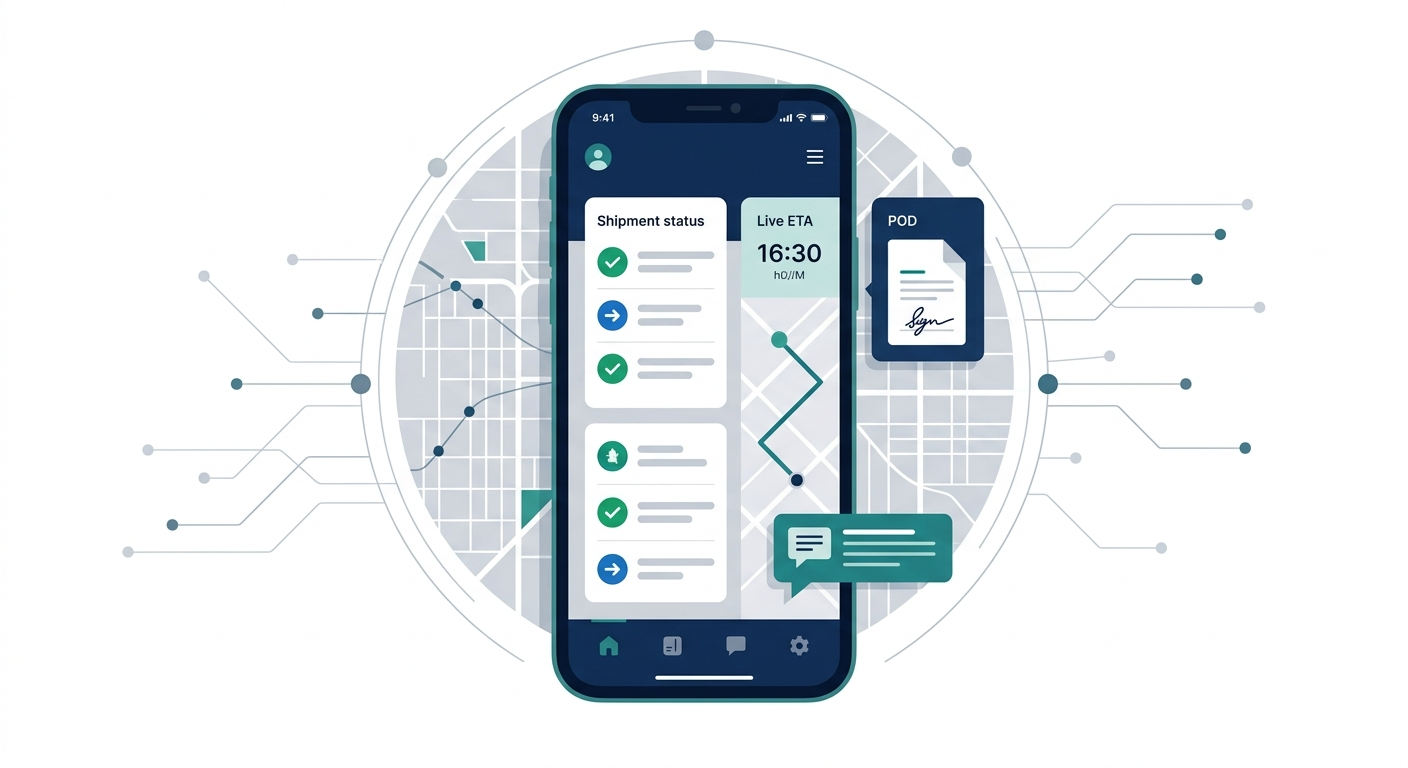
The "paper trail" is the biggest bottleneck in logistics billing. Waiting for a driver to return to the terminal with a physical Proof of Delivery (POD) before invoicing the client creates a massive cash-flow gap.
The Workflow:
The driver captures a high-resolution photo of the signed Bill of Lading (BOL) and uploads it instantly via the app. The system uses OCR (Optical Character Recognition) to extract the shipment ID and automatically marks the order as "Delivered" in the central database.
The ROI:
Moving to digital PODs can reduce the "Order-to-Cash" cycle from 14 days to 24 hours, drastically improving liquidity.
Estimated Development Cost: $7,000 – $14,000
In-App Messaging & Push Notifications
Relying on WhatsApp or SMS for professional dispatching is a liability. You lose the audit trail and mix personal with professional communication.
The Workflow:
Dispatchers send route changes or urgent priority updates via push notifications. Drivers acknowledge receipt with a single tap. All communication is logged against the specific shipment ID for future dispute resolution.
Estimated Development Cost: $5,000 – $10,000
2. Intelligent Routing and Load Optimization
Fuel is one of the highest variable costs in transport. If your trucks are running empty miles or taking inefficient routes, you are literally burning your profit margins. This is where Transport management system development shifts from a luxury to a necessity.
Route Optimization Engine
A great logistics app doesn't just show the shortest path; it calculates the most efficient path based on vehicle weight, height restrictions, traffic patterns, and delivery windows.
The Technical "How":
The engine uses a combination of Dijkstra’s algorithm and real-time traffic data APIs to sequence multiple drops. It considers "Time Windows"—ensuring the driver arrives at Client A between 8 AM and 10 AM and Client B after 2 PM, without backtracking.
The ROI:
Optimized routing typically reduces total mileage by 10-20%, leading to a direct decrease in fuel consumption and vehicle wear and tear.
Estimated Development Cost: $12,000 – $22,000
AI-Powered Load Matching
For companies managing their own carriers or operating a marketplace, the "Empty Mile" problem is the enemy. AI load matching ensures that every truck leaving a facility is at maximum capacity.
The Scenario:
A truck delivers a load of electronics to Chicago. Instead of returning empty to Detroit, the AI scans available shipments and matches the driver with a nearby load of automotive parts heading back to Detroit that fits the truck's remaining capacity and the driver's remaining Hours of Service (HOS).
The ROI:
Increasing the load factor by 10% can move a trucking company from a break-even point to a significant profit margin.
Estimated Development Cost: $15,000 – $30,000
3. The Client Experience: Transparency as a Competitive Advantage
In B2B logistics, the "black hole" period—the time between shipment pickup and delivery where the client has no updates—is where customer dissatisfaction grows. Custom logistics software solves this by turning transparency into a product.
Customer Tracking Portal & Real-Time Visibility
Clients shouldn't have to call your office to know where their freight is. They should have a branded interface that provides a live map view of their shipment.
The Workflow:
The app pipes GPS data from the driver's device to a client-facing dashboard. The client sees the truck moving in real-time, accompanied by a dynamic ETA that updates based on current traffic.
The ROI:
This reduces "Where is my stuff?" (WISMO) inquiries by up to 70%, freeing up your customer service team to focus on sales rather than tracking.
Estimated Development Cost: $10,000 – $20,000 (Integrated with GPS features)
Dynamic Pricing Engine
Fixed pricing models often fail to account for sudden spikes in fuel costs or urgent "last-minute" shipment requests. A dynamic pricing engine allows you to adjust rates based on demand, urgency, and distance.
The Workflow:
The system analyzes current capacity and market demand. If a client requests a "Rush" delivery during a peak season, the engine automatically applies a surge multiplier to the base rate, ensuring the company is compensated for the priority effort.
Estimated Development Cost: $12,000 – $25,000
4. Back-Office Synchronization and Infrastructure
A mobile app is only as good as the engine powering it. Without a robust backend, you just have a pretty interface with no data integrity. This is the core of Logistics software development.
The Full Admin Dashboard
The "Brain" of the operation. The admin dashboard allows dispatchers to see the entire fleet on one screen, manage driver schedules, and monitor KPIs in real-time.
Key Capabilities:
Driver Performance Tracking: Monitoring idling time, fuel efficiency, and on-time delivery rates.
Load Management: Drag-and-drop interface to assign loads to available drivers.
Alert System: Immediate red-flags if a truck deviates from its assigned route or stops unexpectedly for too long.
Estimated Development Cost: $15,000 – $30,000
Third-Party API Integrations (ERP, TMS, Maps)
Your logistics app cannot exist in a vacuum. It must talk to your accounting software (QuickBooks/SAP), your existing Transport Management System, and high-fidelity map providers (Google Maps/HERE/Mapbox).
The Workflow:
When a shipment is marked "Delivered" in the mobile app, an API call is sent to the ERP system to generate an invoice and a second call is sent to the CRM to notify the account manager that the client's order was successful.
Estimated Development Cost: $10,000 – $25,000
5. Risk Mitigation, Payments, and Compliance
Logistics is a high-risk business. From insurance liabilities to payment delays, the administrative burden of compliance can stifle growth. Custom TMS for trucking companies should automate these safeguards.
Carrier Onboarding & Verification
If you work with third-party carriers, verifying their insurance, licenses, and safety ratings manually is a nightmare.
The Workflow:
Carriers upload their documents (MC number, insurance certificates) directly through the app. The system integrates with government databases to verify the validity of these documents in real-time. If an insurance policy expires, the system automatically flags the carrier as "Inactive" and prevents them from being assigned new loads.
Estimated Development Cost: $6,000 – $12,000
In-App Payments & Payouts
Waiting for checks to clear is an outdated model. Integrated payment gateways allow for faster settlements, which is a huge incentive for high-quality drivers to join your network.
The Workflow:
Upon digital POD upload, the system triggers an automatic payment process. The driver receives their payout via ACH or digital wallet, minus any agreed-upon commissions, immediately after the delivery is verified.
Estimated Development Cost: $8,000 – $18,000
Analytics & Reporting Module
You cannot manage what you cannot measure. A dedicated reporting module turns raw GPS and delivery data into business intelligence.
Vital Metrics to Track:
Cost per Mile (CPM): The ultimate health metric for any transport company.
On-Time Delivery (OTD) Percentage: The primary KPI for customer satisfaction.
Driver Utilization Rate: How many hours a driver is actually moving freight vs. idling.
Estimated Development Cost: $8,000 – $18,000
6. Hypothetical Case Study: Transforming "MidWest Freight Solutions"
To understand the impact of these features, let's look at a hypothetical scenario involving MidWest Freight Solutions (MFS), a mid-sized trucking company with 40 power units and 80 trailers.
The "Before" State:
MFS relied on phone calls and a basic spreadsheet.
Pain Point 1: Dispatchers spent 4 hours a day just calling drivers to get status updates.
Pain Point 2: Invoicing took 10 days because they had to wait for physical PODs to be turned in.
Pain Point 3: Deadhead miles were at 22% because load matching was done by memory and intuition.
The Solution:
MFS invested in Supply chain management tools and a custom mobile app featuring:
Real-time GPS & Geofencing (to eliminate status calls).
Digital PODs (to accelerate invoicing).
AI-Powered Load Matching (to reduce empty miles).
A Central Admin Dashboard (for total visibility).
The "After" State (12 Months Later):
Administrative Efficiency: The time spent on "status check" calls dropped by 85%. Dispatchers could now manage more trucks without increasing headcount.
Cash Flow Improvement: The billing cycle dropped from 10 days to 2 days. This allowed MFS to invest in five new trucks without taking on high-interest debt.
Profitability: Deadhead miles were reduced from 22% to 11%. By simply filling more backhauls using the AI matching engine, their net profit margin increased by 7%.
7. Architecture for Scale: How to Build it Right
When developing a logistics app, the temptation is to build a "monolith"—one giant piece of software. This is a mistake. For a system to be resilient, it must follow an API-First Architecture.
The Three-Tier Approach:
The Presentation Layer (Mobile App): Built with frameworks like React Native or Flutter. This ensures the app works on both Android and iOS without doubling the development cost.
The Logic Layer (API Gateway): A robust backend (Node.js or Python) that handles the "heavy lifting"—calculating routes, matching loads, and processing payments.
The Data Layer (Cloud Database): Using AWS or Azure to ensure the system can handle thousands of GPS pings per second without crashing.
Why this matters for ROI:
If you decide to add a new feature—like an IoT sensor to monitor temperature for cold-chain logistics—an API-first approach allows you to plug in that new data source without rewriting the entire app.
Summary of Value
A logistics mobile app is not just a tool for drivers; it is a strategic asset that optimizes every single cent of your operational spend. By focusing on the "Last Mile" (Digital PODs and GPS), the "Middle Mile" (Route Optimization and Load Matching), and the "Back Office" (Admin Dashboards and ERP Integration), you transform your business from a reactive operation into a proactive, data-driven powerhouse.
The transition from manual processes to Custom logistics software is the difference between struggling to survive in a low-margin industry and dominating your market through operational excellence.
FAQs (Frequently Asked Questions)
Q1: How long does it typically take to develop a custom logistics mobile app?
A: Depending on the complexity, a Minimum Viable Product (MVP) focusing on core features like GPS tracking and digital PODs usually takes 3 to 5 months. A full-scale enterprise system with AI load matching and deep ERP integrations typically takes 6 to 12 months of iterative development.
Q2: Can a custom app integrate with my existing legacy software?
A: Yes. Most modern Logistics software development utilizes APIs (Application Programming Interfaces) to bridge the gap between new mobile interfaces and old legacy databases. If your legacy system has a database accessible via SQL or a basic API, we can sync the data in real-time.
Q3: Will a mobile app actually reduce my fuel costs?
A: Absolutely. By implementing a Route Optimization engine, you eliminate unnecessary mileage and reduce idling time. When you combine this with AI Load Matching to reduce deadhead miles, the impact on your fuel bill is immediate and measurable.
Q4: Is the data in a custom logistics app secure?
A: Security is a primary concern in B2B logistics. Professional development includes end-to-end encryption for data in transit, secure OAuth 2.0 authentication for user logins, and role-based access control (RBAC) to ensure drivers only see their own loads while admins see the entire fleet.
Ready to Eliminate Operational Leakage?
Stop letting your profits slip through the cracks of manual spreadsheets and endless phone calls. Your fleet deserves a system that works as hard as your drivers do.
Whether you are looking to build a Custom TMS for trucking companies from scratch or want to integrate advanced Fleet management software solutions into your existing workflow, our team of senior engineers and logistics experts is ready to help.
Don't leave your margins to chance.