Your gym's member app just cost you $340,000 in annual revenue. Not because the app is broken. Because it works too well at showing members bad data.
Here's the ugly truth about fitness tracking app development that nobody talks about at conferences. The hard part isn't the food database. It's making three different systems agree on how many calories a human actually burned today.
The $340K Mistake Happening Right Now
Picture a 40-location boutique gym chain. They run Mindbody for class scheduling and check-ins. They use ABC Fitness for billing and membership management. Last year, they hired a dev shop to build a MyFitnessPal-like app so members could log food and see their fitness data in one place.
Sounds simple. It wasn't.
Here's what happened. A member checks into a spin class through Mindbody. The class auto-logs "450 calories burned" based on a generic formula. That same member wears an Apple Watch, which also tracks the workout and sends it to Apple Health. The new gym app pulls that Apple Health data too.
Now the member has two calorie burn entries for one workout. Their daily calorie budget looks completely wrong. They think they can eat an extra 450 calories, except that number never existed.
Within one month, 22% of app users manually turned off HealthKit sync out of frustration. Support tickets about "wrong calorie numbers" cost the gym $18,000 a month to handle. Members who couldn't trust the numbers stopped opening the app. Some canceled memberships entirely, blaming the "buggy app" instead of the syncing logic underneath it.
Total damage over 12 months: roughly $340,000 in churn-driven revenue loss, plus the original $180,000 development cost for an app members didn't trust.
This is not a coding bug. This is an architecture failure. And it happens to almost every gym or wellness brand attempting myfitnesspal clone app development without understanding the plumbing MyFitnessPal spent a decade perfecting.
Why This Keeps Happening
Most dev teams treat apple health/healthkit integration as a checkbox. Connect the API, pull the data, done.
But HealthKit doesn't work like a normal database. It's a permission-based, event-driven system that stores data from dozens of sources at once. Your Apple Watch, your Peloton bike, your gym's check-in kiosk, a manual entry you typed yourself. All of it lands in the same bucket unless you build rules to sort it out.
Without a deduplication layer, you get exactly what that gym chain experienced. Duplicate entries. Conflicting numbers. Members who stop trusting your product.
The same friction shows up in fitness tracking app development when you connect to Trainerize for coaching workouts or ABC Fitness for facility check-ins. Each system has its own idea of "truth." Your app has to pick one and enforce it everywhere.
The Counter-Intuitive Insight
Here's the part that surprises most product owners. Adding more integrations does not make your app more valuable. It makes it more fragile.
Every extra data source you connect (Mindbody, Apple Watch, MyFitnessPal-style barcode logs, Fitbit, Strava) is another chance for numbers to contradict each other. The gyms that win with fitness apps aren't the ones with the most integrations. They're the ones with the fewest conflicts.
Fewer, well-managed sync points beat a dozen loosely connected ones every single time. MyFitnessPal itself limits how aggressively it pulls duplicate workout data for exactly this reason.
What The Right Architecture Actually Looks Like
Let's break down how a MyFitnessPal-like app should actually be built, piece by piece, so you don't repeat that $340K mistake.
1. A Single Source of Truth Layer
Before any data touches your app's UI, it passes through a reconciliation layer. This layer decides which source wins when two systems report the same activity.
For example, if a workout exists in both Apple Health and your gym's check-in system, the reconciliation layer picks one (usually the wearable, since it's more precise) and suppresses the duplicate. Members never see two entries for the same class.
2. HealthKit Sync With Boundaries
Good apple health/healthkit integration doesn't grab everything. It requests specific data types only: steps, active energy, workouts, and weight, depending on what your app actually needs.
Background delivery should be throttled and time-stamped carefully. HealthKit updates aren't always instant, so your app needs a "last synced" indicator instead of pretending data is live when it isn't.
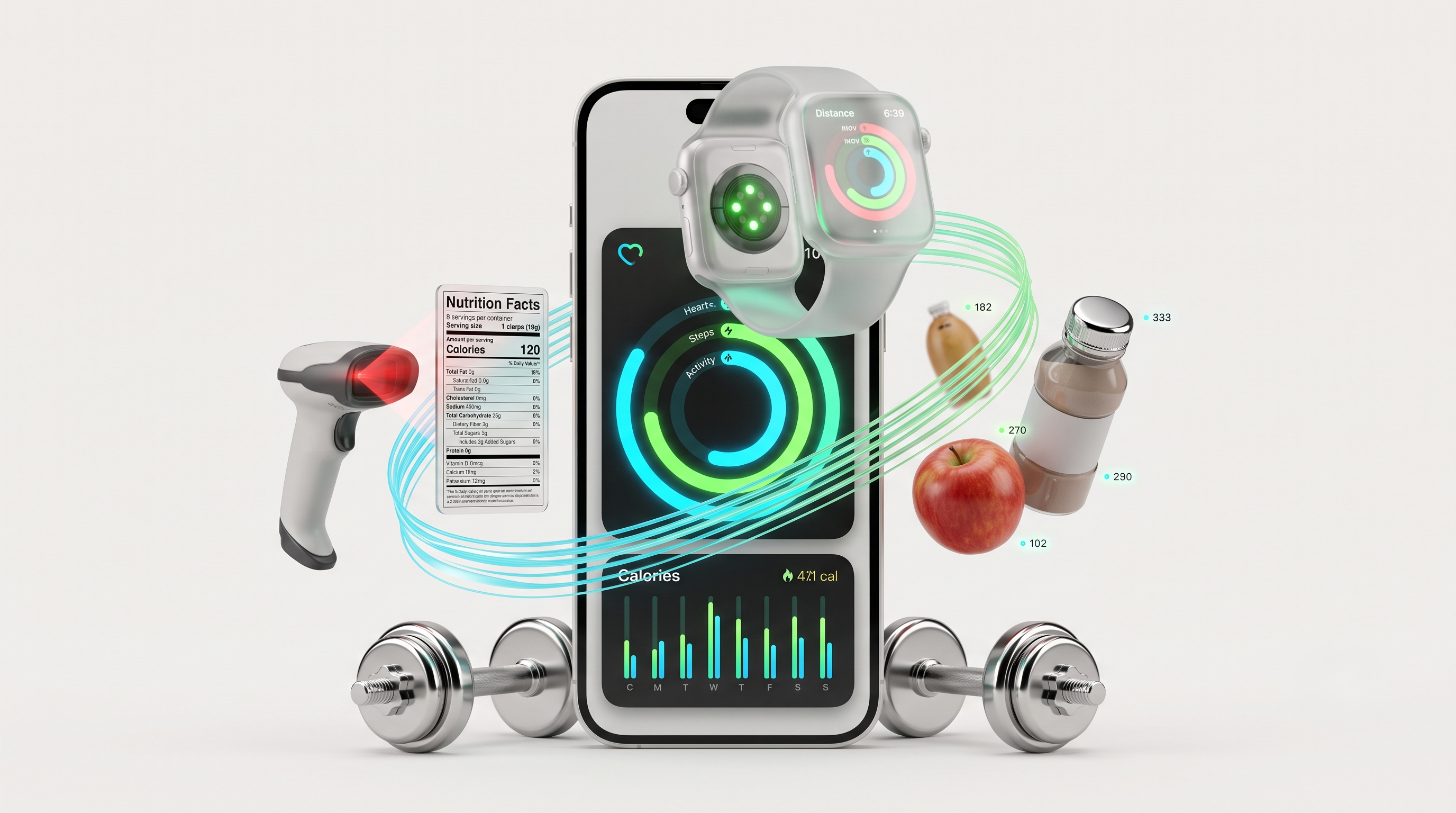
3. Smarter Barcode Scanner Food Logging
Barcode scanner food logging feels simple until you realize food databases aren't standardized. A product barcode in the US might return different nutrition info than the same barcode scanned in the UK.
The fix is layering multiple food data sources (like USDA and a licensed commercial database) with a fallback system. If the primary database has no match, the app tries a second source before asking the user to manually enter it. This alone cuts "no match found" complaints by more than half in most builds we've studied.
4. Conflict Resolution Rules for Multi-System Gyms
If your gym already runs Mindbody or ABC Fitness, your new app cannot operate in a vacuum. You need clear rules for which system owns which data:
Class attendance and scheduling stays owned by Mindbody or ABC Fitness
Calorie burn and workout intensity gets owned by HealthKit or the wearable device
Food logging and daily nutrition targets stay fully owned by your app's own database
When each system has one clear job, duplicate data practically disappears.
Building This Specifically For Gyms
If you're trying to build a myfitnesspal-like app for gyms, the calculus is different than building a standalone consumer app. You're not just competing with MyFitnessPal. You're layering nutrition tracking on top of systems your gym already depends on for revenue.
That means your architecture needs three extra considerations most generic dev shops miss.
First, your app needs to respect existing membership data instead of duplicating it. If ABC Fitness already stores a member's join date, billing status, and class history, don't rebuild that logic inside your new app. Pull it through an API instead. Duplicate member records are one of the fastest ways to create billing disputes.
Second, your food logging system needs to work offline. Gyms have notoriously bad basement WiFi. A member trying to scan a protein bar barcode in a locker room with no signal should still get a result, even if it's a cached local database lookup that syncs once connection returns.
Third, your onboarding needs to explain the sync logic to users in plain language. Most member confusion isn't a technical failure, it's a communication failure. A simple screen saying "we use your Apple Watch data for calories burned, and Mindbody for your class history" prevents a huge share of support tickets before they start.
The Real Cost Comparison
Let's be blunt about numbers, because vague promises don't help CIOs make decisions.
A poorly architected MyFitnessPal-like app costs you in slow, invisible ways: churn from bad data, support tickets from confused members, and engineering hours spent patching sync bugs after launch instead of before it.
A properly architected one costs more upfront in planning and reconciliation logic, but it pays that back fast. Gyms that build clean integration layers typically see support tickets related to data accuracy drop by 60 to 70% within the first quarter after launch.
That's the difference between an app members open every day and one they quietly delete.
What CIOs Should Ask Before Approving The Build
If you're the one signing off on this project, ask your dev partner these questions before a single line of code gets written.
How will duplicate workout entries between HealthKit and our existing gym software get resolved? If the answer is vague, that's a red flag.
What happens when the barcode database has no match for a scanned product? There should be a clear fallback plan, not a dead end for the user.
How will member data ownership be split between our existing systems (Mindbody, ABC Fitness, Trainerize) and the new app? If nobody has mapped this out on paper, the build is not ready to start.
These aren't nice-to-have questions. They are the difference between a $340,000 mistake and a member app people actually trust.
Bottom Line
Fitness tracking app development isn't hard because of UI design or workout libraries. It's hard because you're reconciling data from systems that were never designed to talk to each other.
Get the integration framework right, and your app becomes the calm, trustworthy hub members check every morning. Get it wrong, and you've built an expensive way to confuse people out of their memberships.
If you're planning to build a myfitnesspal-like app for gyms or add serious nutrition tracking to an existing fitness platform, the architecture decisions you make in week one will determine whether members trust your numbers in month twelve.
Talk to a team that has actually solved this reconciliation problem before, not one that's learning it on your budget.
How long does it actually take to build a MyFitnessPal-like app with HealthKit sync done correctly
Most well-scoped builds take 4 to 6 months for a solid version one, including the reconciliation layer.
Rushing this timeline is exactly how gyms end up with the duplicate data problem described above. Budget extra time specifically for testing sync conflicts across multiple devices and gym management systems before launch, not after.
What happens if our gym already has years of member data inside Mindbody or ABC Fitness
Your new app should pull that data through an API connection rather than recreating it from scratch.
This protects billing history, class attendance records, and membership status while letting the new app focus purely on nutrition and wellness tracking. A good dev partner will map this integration during discovery, before writing any code.
Can we skip the barcode scanner and just let members type in food manually to save development cost
You can, but expect a sharp drop in daily engagement.
Manual entry adds friction, and friction kills habit-forming apps fast. Barcode scanner food logging is one of the biggest reasons MyFitnessPal built such loyal daily users, and skipping it usually costs more in lost engagement than it saves in development budget.