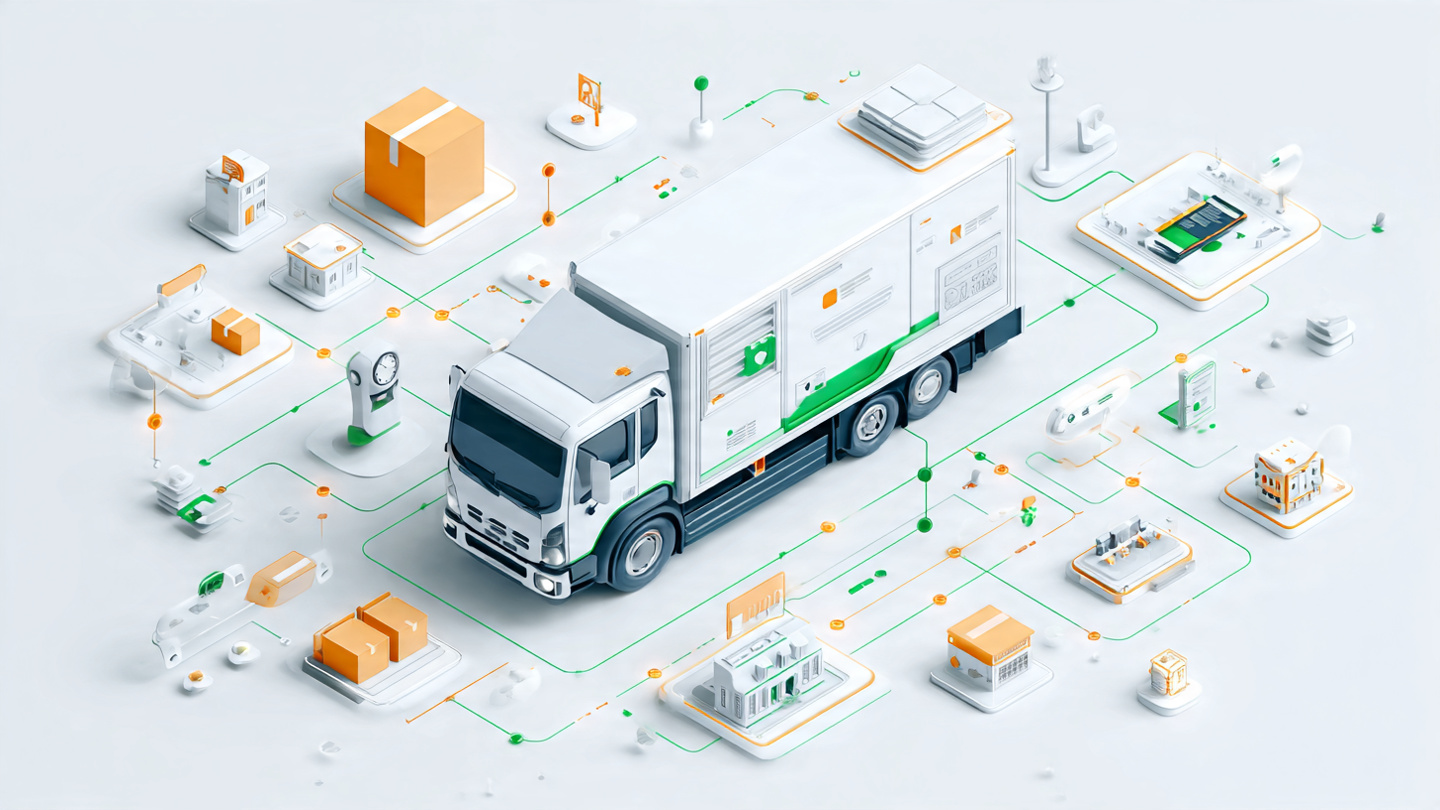
Your 3 p.m. route review is going sideways. Again.
A driver is stuck in a cul-de-sac because the map pin sent him to a backyard fence. A customer is furious because her "out for delivery" package is still sitting at the depot. Your dispatcher is juggling three WhatsApp groups, a GPS spreadsheet, and a phone call that just dropped.
Sound familiar? You don’t need another whitepaper telling you that last-mile delivery is expensive. You already know it eats 53% of your total shipping cost [1]. You need to know what it actually takes to build a delivery app that fixes this mess — and what you’ll really pay for it.
So let’s talk about it. Not in abstract strategy-speak. In the language of dispatchers, CTOs, and founders who’ve watched a $2 million delivery operation crumble because the routing engine was a spreadsheet in disguise.
Why Now? The Last-Mile Has Become a Software Problem Disguised as a Logistics Problem
For years, you could brute-force last-mile delivery with more vans, more drivers, and a dispatch manager who never slept. That era is over. Driver shortages, fuel volatility, and customers who expect Amazon-grade precision from everyone else have changed the math.
In 2024 and 2025, the companies winning last-mile aren’t the ones with the biggest fleet. They’re the ones with the tightest feedback loop between driver, route, and customer. That feedback loop is software. And the core of that software is a delivery app that does more than show dots on a map.
Here’s the thing: the marginal cost of a missed delivery, a reroute, or a failed first attempt has exploded. One failed delivery in grocery or pharma can cost $20–$50 in redelivery, customer service, and goodwill. Multiply that across 500 stops a day and you’re bleeding money that no fleet expansion can fix.
Real-World Scenario: How a $40M Courier Company Stopped Guessing
Two years ago, I worked with a regional courier handling 12,000 parcels daily across the Midwest. They had a solid fleet. Great drivers. But their last-mile operation was a duct-tape job: a legacy TMS, driver phones with consumer GPS apps, and customer updates via SMS blast.
The pain was predictable. Drivers were clocking 3.2 hours of extra drive time per day because routes were planned by postcode, not traffic reality. Customers called in droves. The ops manager had a nickname for 10 a.m. on Mondays: "The Swear Hour."
We built a new last-mile platform. The key wasn’t fancy AI. It was a clean architecture: real-time route optimization, a driver app with offline-capable proof-of-delivery, and a customer-facing tracking layer. The engine pulled live traffic, stop priorities, and vehicle capacity into a single optimization run every 15 minutes.
In six months, average drive time per route dropped 27%. First-attempt delivery rate climbed from 84% to 96%. Customer complaints fell by half. The biggest surprise? Driver retention improved. Turns out drivers hate getting yelled at by dispatchers as much as customers hate waiting for packages. Good software made both sides less miserable.
That’s the promise. But only if you build it right.
What "Architecture" Actually Means Here
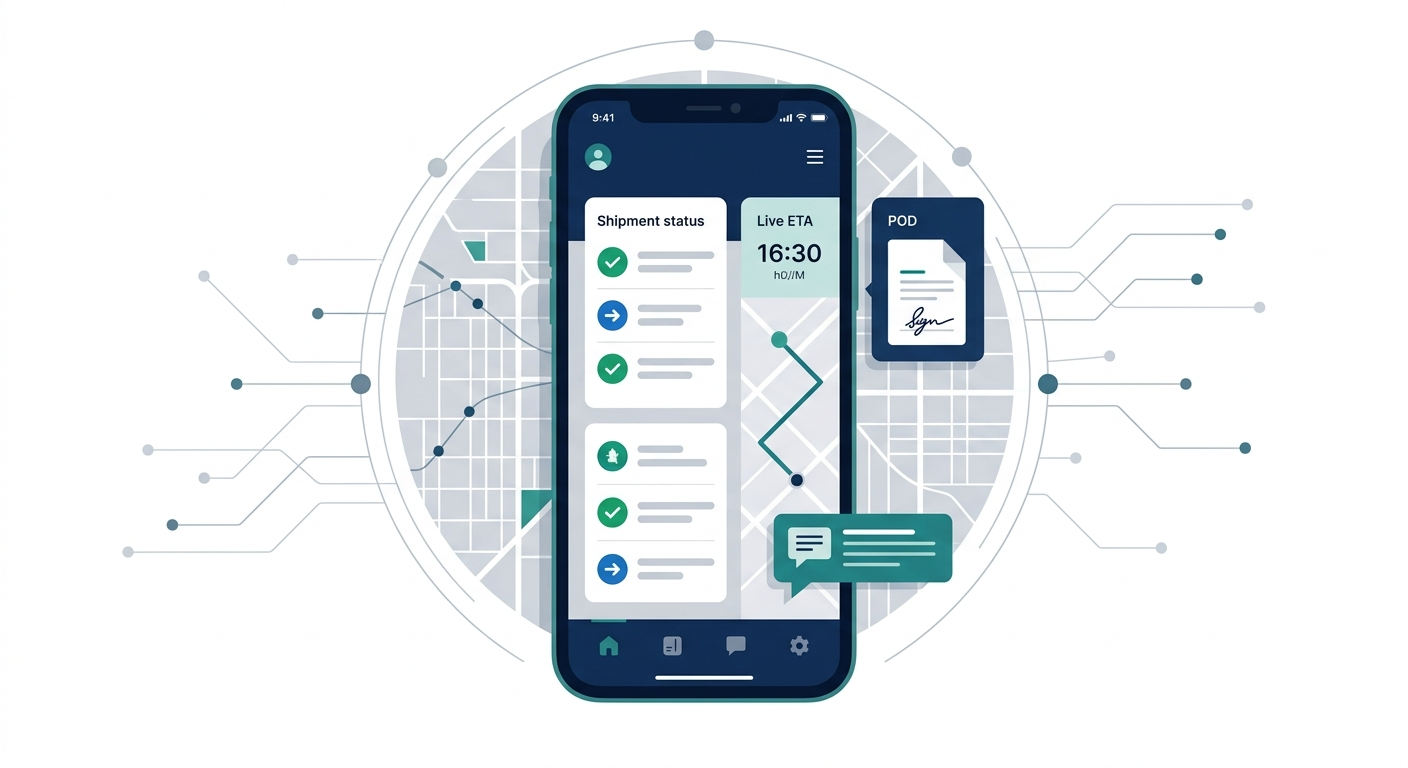
When people say "delivery app architecture," they usually mean the tech stack. That’s only half the story. The architecture you care about is the one that connects four moving parts: the customer, the dispatcher, the driver, and the operational data.
Get any of these wrong, and the app becomes a beautiful dashboard nobody trusts.
The Four Pillars
Customer app. This is where expectations get set. Real-time tracking, ETA updates, delivery windows, and self-service rescheduling. If you can’t show the customer where the driver is and when they’ll arrive, you’re already behind.
Driver app. This is where the work happens. Turn-by-turn navigation, stop sequence, proof-of-delivery capture, barcode scanning, and exception logging. It needs to work offline. Drivers go into basements, parking garages, and rural dead zones. A driver app that panics without signal is a failed app.
Dispatcher/admin panel. This is your nerve center. Live map view, route re-optimization, load balancing, issue triage, and performance reporting. It should feel like a mission control room, not a spreadsheet.
Routing and optimization engine. This is the brain. It takes orders, constraints, vehicle capacity, driver hours, traffic, and customer time windows and produces the best possible sequence of stops. It should recalculate in real time when things go wrong.
The Tech Stack You’ll Actually Hear About
For a mid-to-enterprise-grade last-mile platform, the typical stack looks like this:
Frontend: React or Vue for the web dashboards, React Native or Flutter for cross-platform driver/customer apps, or native Swift/Kotlin if you want the smoothest performance.
Backend: Node.js, Python, Java, or Go. The routing engine is often Python-based or uses a specialized solver like OptaPlanner, GraphHopper, or Google OR-Tools.
Database: PostgreSQL for transactional data, Redis for caching and real-time state, and often a time-series database for telemetry and route history.
Maps & routing: Google Maps, Mapbox, or Here for mapping; route optimization may use OSRM, GraphHopper, or a proprietary solver.
Notifications: Firebase, Twilio, AWS SNS, or OneSignal for SMS, push, and email updates.
Cloud: AWS, GCP, or Azure. Most platforms start containerized with Docker/Kubernetes and lean on managed services for scaling.
Real-time tracking: WebSockets or MQTT for live location streaming. GPS sampling every 5–15 seconds is standard.
The architecture is only as good as the data flowing through it. Garbage in, garbage out. If your address data is messy, no algorithm in the world will save you. Fix the addresses before you optimize the routes.
Features That Matter (And Features That Don’t)
Not every feature is worth building in version one. I’ve seen companies blow six months on a customer-facing feature nobody used while their drivers still couldn’t scan a barcode reliably.
Build These First
Route optimization. The single highest ROI feature. It directly cuts fuel, labor, and miles driven.
Real-time driver tracking. Dispatch needs to see where drivers are without calling them.
Proof-of-delivery. Photo, signature, barcode scan, and notes. It reduces disputes and liability.
Customer notifications. Proactive SMS/push with ETA and arrival alerts. This alone cuts "where is my order" calls by 30–50%.
Offline mode. Drivers cannot lose access when they lose signal.
Exception handling. Wrong address, refused delivery, damaged parcel, safe-drop instructions. Captured at the stop, not hours later.
Analytics dashboard. On-time performance, first-attempt success rate, cost per stop, driver utilization.
Build These Later (Or Not At All)
Customer chatbot. Nice to have, rarely the make-or-break feature.
AI predictive ETAs. Worth it only after you have clean, high-volume historical data.
Gamification for drivers. Only works if your culture already supports it. Otherwise it feels patronizing.
Blockchain traceability. Almost never the right answer for a domestic last-mile operation.
Counter-Intuitive Insight: The Best App Isn’t the One With the Most Features
Everyone wants to brag about machine learning and predictive analytics. But the best last-mile delivery platforms I’ve seen are boring in the right ways. They’re fast. They’re reliable. They don’t crash when a driver’s phone hits 12% battery. They update the customer before the customer asks.
The highest ROI feature in last-mile is usually the simplest: a reliable route that re-optimizes in real time and a driver who can prove they completed the stop. Everything else is theater.
I’ll say it plainly: most failed delivery apps fail because they optimize for the boardroom demo, not the driver’s actual day. The drivers are the users. Build for them first.
The Real Cost Breakdown
Let’s talk numbers. Not vague ranges, but realistic ballparks for a mid-sized B2B or enterprise last-mile platform built from scratch in 2024/2025.
I’m assuming a US or Western Europe development rate for an experienced team. Costs will be lower in Eastern Europe or South Asia and higher in premium tech hubs like San Francisco.
Typical Team Composition
Role | Size | Monthly Cost Range (US/Western EU) |
|---|---|---|
Product Manager | 1 | $12,000–$18,000 |
Backend Engineer | 2–3 | $18,000–$30,000 |
Frontend Engineer | 2 | $14,000–$24,000 |
Mobile Developer | 2 | $16,000–$28,000 |
DevOps / Cloud Engineer | 1 | $14,000–$22,000 |
QA Engineer | 1–2 | $9,000–$16,000 |
UX/UI Designer | 1 | $8,000–$14,000 |
Routing / Algorithm Specialist | 0.5–1 | $10,000–$20,000 |
Total monthly burn: roughly $100,000–$170,000 for a full in-house team. A typical MVP takes 4–6 months. A robust enterprise-grade platform takes 9–14 months.
Development Phase Costs
Phase | Duration | Cost Range |
|---|---|---|
Discovery & architecture | 4–6 weeks | $15,000–$40,000 |
MVP (customer + driver + dispatcher) | 4–6 months | $200,000–$450,000 |
Full enterprise platform | 9–14 months | $500,000–$1,500,000 |
Ongoing maintenance & support | annual | 20–30% of initial build cost |
Third-Party & Operational Costs (Annual)
Service | Annual Cost Range |
|---|---|
Cloud hosting (AWS/GCP/Azure) | $30,000–$150,000 |
Map & routing APIs | $20,000–$100,000 |
SMS / push notifications | $10,000–$60,000 |
GPS/telematics hardware or integration | $15,000–$80,000 |
Security, monitoring, CI/CD tooling | $10,000–$40,000 |
Integrations (TMS, ERP, WMS) | $20,000–$100,000+ |
Build vs. Buy vs. Hybrid
Here’s where it gets interesting. Building from scratch is expensive, but it’s not always the wrong call. If last-mile is your core business, ownership of the platform is a strategic asset.
If you just need basic tracking and proof-of-delivery, buying an off-the-shelf solution like Onfleet, Route4Me, or Bringg will be faster and cheaper. Expect $5,000–$30,000 per month in licensing depending on scale.
The hybrid approach — buying a base platform and building custom modules on top — often gives the best ROI. You get speed to market for the standard stuff, and you only build what differentiates you.
Actionable Framework: How to Scope Your Build
If you’re a logistics manager, CTO, or founder staring at a blank page, here’s a practical roadmap.
Define the pain, not the feature. Start with the operational problem. Is it failed first deliveries? Too much dispatcher time? Driver churn? The feature set flows from the pain.
Audit your data. Clean up addresses, delivery windows, and historical route data before you build anything. Dirty data will sabotage your optimization engine.
Start with the driver experience. If drivers won’t use it, the rest is useless. Test the driver app with real drivers on real routes before the customer app is polished.
Pick one measurable KPI. On-time delivery rate. First-attempt success. Cost per stop. Driver utilization. Optimize for one metric first, then expand.
Build the MVP with real users, not test scripts. Run a pilot with 5–10 drivers for 4–6 weeks. The bugs you find in real traffic will not appear in a staging environment.
Plan for integration from day one. Your app will need to talk to a TMS, WMS, ERP, or e-commerce platform. APIs and data schemas matter more than UI polish.
Plan for scale, but don’t over-engineer it. Design for 10x volume, but build for your current volume. Premature scaling is how budgets explode.
FAQ: What Skeptical Buyers Actually Ask
1. Can’t we just use Google Maps and a WhatsApp group? Why build anything custom?
You can, right up until the point where it hurts. Google Maps doesn’t optimize multi-stop routes with time windows, vehicle capacity, and driver breaks. WhatsApp groups don’t scale, and they don’t give you proof-of-delivery or analytics. If you’re doing fewer than 50 stops a day, duct tape works. Above that, you’re leaving money on the road.
2. How long before we see ROI?
For a well-built platform, most operators see measurable ROI in 6–12 months. The fastest wins come from route optimization and reduced customer service calls. If your current first-attempt success rate is below 90%, the ROI case is usually easy. If you’re already above 95%, the gains will come from utilization, fuel, and driver retention.
3. What’s the biggest risk in building this?
The biggest risk is building the wrong thing. Not the wrong tech stack — the wrong workflow. Companies fall in love with features their operations team doesn’t actually need, while ignoring the basics like offline mode, barcode scanning, and clean exception handling. The fix is simple: involve drivers and dispatchers in every sprint review, not just at kickoff.
The Bottom Line
Last-mile delivery software is not a nice-to-have anymore. It is the operating system of your delivery business. But the software is only as good as the operational thinking behind it. A flashy app with bad routing will make you fail faster. A simple app with clean data, good routes, and happy drivers will beat it every time.

If you’re planning to build, start small. Start with the driver. Start with the pain. And measure everything.
Ready to scope your last-mile delivery app? Book a 30-minute architecture review with our team and we’ll walk through your current operations, your biggest friction point, and what a realistic build plan looks like — no generic pitch deck required.
[1] McKinsey & Company. "Last-mile delivery: The next big thing in logistics." Based on widely cited industry analysis that last-mile delivery accounts for approximately 50–55% of total shipping costs.